
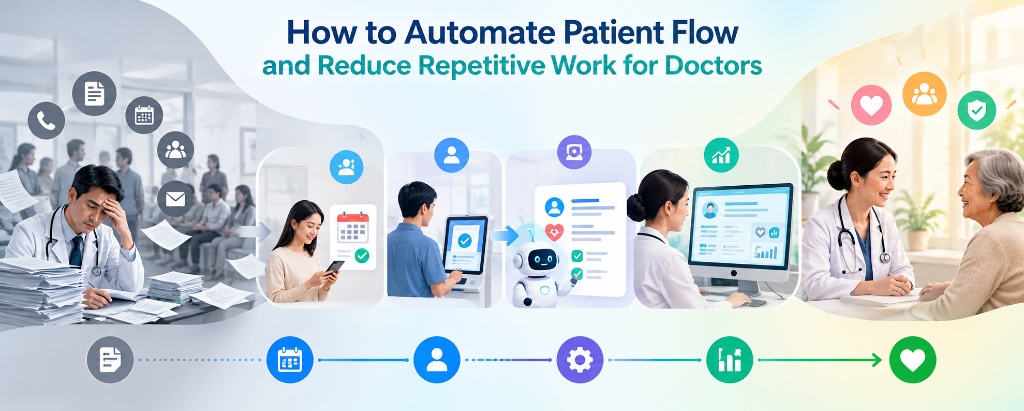
Walk into almost any outpatient clinic, and you will witness a scene that has become standard across modern medicine: a physician sitting in an examination room, typing on a keyboard, staring into an electronic health record (EHR) monitor while speaking to a patient sitting a few feet away. The doctor is not ignoring the patient out of indifference. They are frantically racing against a mountain of mandatory administrative inputs: clicking through multi-nested menus, reconciling duplicate medication lists, transcribing vital signs that a nurse already wrote down on a slip of paper, and logging billing codes before their fifteen-minute appointment window evaporates.
This administrative burden is not an incidental annoyance; it is a structural crisis in healthcare delivery. In a landmark time-motion study published in the Annals of Internal Medicine, researchers led by Dr. Christine Sinsky tracked ambulatory physicians across specialties and discovered that for every single hour doctors spend in direct clinical face time with patients, they spend nearly two additional hours on EHR and administrative desk work. Outside clinic hours, physicians logged another one to two hours of "pajama time" every night, catching up on unfinished clinical notes, reviewing routine lab results, and responding to patient portal inboxes.
The goal of modern healthcare workflow engineering is not to replace physicians with automated diagnostic algorithms. Clinical judgment, diagnostic nuance, and compassionate human care cannot—and should not—be outsourced to software. The true goal is far more urgent and practical: to dismantle the unnecessary administrative friction that surrounds the people providing care.
Achieving that requires a clear guiding philosophy: Technology should work around clinical care. Doctors should not have to work around the technology.
Mapping the Patient Journey: Where Friction Quietly Accumulates
Rather than treating healthcare operations as an abstract technological problem, we have to look at the tangible reality of an ordinary outpatient visit. Consider the typical journey a patient takes through a clinic:
1. Appointment Request ➔ 2. Scheduling & Slotting ➔ 3. Patient Intake & Insurance ➔
4. Visit Prep & Pre-Charting ➔ 5. Clinical Encounter ➔ 6. Note Documentation ➔
7. Orders & Referrals ➔ 8. Post-Care Follow-Through
At every single station of this sequence, operational friction accumulates when systems fail to communicate. When software cannot hand off information reliably, human beings are forced to fill the gap.
To audit any clinic process, operations leaders must ask a simple question at each stage: Does this specific task actually require a physician's medical training?
Checking whether a patient's insurance policy is active does not require an MD. Transcribing a handwritten pharmacy name from a paper clipboard into an EHR field does not require clinical judgment. Verifying that an appointment reminder SMS was received does not require a clinician's attention. Yet in thousands of practices, doctors and certified nurses spend hours every week managing these exact mechanical handoffs.
The Primary Culprits of Repetitive Clinic Overhead
When you inspect where time vanishes inside a medical practice, four recurring operational bottlenecks appear consistently across specialties:
1. The Clipboard Bottleneck (Intake Redundancy)
In countless clinics, a patient arrives fifteen minutes before their appointment, sits in a waiting room, and fills out three pages of paper forms clipped to a plastic board. They write down their name, date of birth, home address, medical history, and current medications.
Twenty minutes later, a medical assistant or front-desk receptionist sits down and manually types those exact details into the clinic's practice management software. If the patient is seeing an outside specialist, a medical records clerk frequently faxes or scans those pages into an unindexed PDF repository, where another staff member must retype them into a second system.
The operational solution is straightforward: collect structured information digitally once. When a patient completes a secure, validated intake flow prior to their visit, that data should map directly into structured EHR fields via standardized healthcare APIs (such as FHIR). The front-desk team verifies identity and eligibility; nobody retypes handwriting.
2. Manual Appointment Coordination
Coordinating schedules remains one of the largest drains on clinic administrative staff. Phone lines ring constantly with routine requests: patients booking annual check-ups, confirming arrival times, asking for driving directions, or requesting routine appointment reschedules.
When appointment scheduling depends entirely on manual telephone tag, receptionists spend hours playing voicemail roulette, and physicians end up with fractured daily schedules full of unfillable late cancellations. As conversational technology matures, routine telephone inquiries can be handled seamlessly by voice automation systems—an evolution we analyzed in our evaluation of voice agents handling business scheduling and customer calls. Predictable booking slots can be managed automatically, reserving clinic staff for patients with complex clinical coordination needs.
3. Information Hunting Across Disconnected Screens
Before stepping into an exam room, a physician needs a quick, coherent understanding of why the patient is here, what happened at their last visit, and whether recent lab results or imaging studies have arrived.
In fragmented systems, finding those answers requires hunting through five different EHR tabs, opening a third-party radiology viewer, sifting through an unindexed fax inbox, and reading through twenty pages of historical progress notes. This "click tax" burns three to five minutes before every single encounter. Pre-visit synthesis tools can pull relevant data into a unified encounter brief, allowing the physician to review key clinical markers in thirty seconds.
4. Humans Acting as the Integration Layer
Perhaps the most egregious administrative failure in modern healthcare is requiring humans to act as manual data conduits between software applications. A doctor determines that a patient needs an MRI, enters the order in their EHR, and then an administrative assistant opens an insurance prior-authorization portal, copies the patient's demographics, pastes the clinical justification, switches back to the EHR, checks the approval status three days later, and manually phones the imaging center.
The Core Integration Principle: People should never have to function as the copy-paste bridge between software systems. If two systems need to exchange data, that exchange must happen through an API or automated pipeline, not through an employee’s clipboard.
A Realistic Workflow Transformation: Before and After
To understand how these concepts alter clinical operations, consider a detailed before-and-after view of an outpatient specialty referral:
- Primary care fax arrives at clinic; sits in paper tray.
- Clerk scans fax into general document folder.
- Clerk manually dials patient to schedule visit; leaves voicemail.
- Patient calls back; clerk types details into scheduling calendar.
- Patient arrives 20 mins early to fill out paper intake forms.
- Medical assistant manually types intake medications into EHR.
- Doctor spends 6 minutes hunting for the original referral note.
- Doctor types clinical note during the entire 15-minute visit.
- Doctor spends 90 minutes after clinic finishing charts at home.
- Direct digital referral ingested via standardized API.
- Automated rules verify insurance eligibility and match patient ID.
- Patient receives secure SMS with self-scheduling link and digital intake.
- Patient enters medications and history on mobile device; syncs to EHR.
- Pre-visit synthesis compiles previous labs and chief complaint for doctor.
- Doctor conducts visit with 100% eye contact; ambient scribe drafts SOAP note.
- Doctor reviews, edits, and approves the generated draft note in 90 seconds.
- Prescriptions and lab orders routed deterministically; care plan sent to patient.
- Doctor leaves clinic on time with zero backlog of unfinished charts.
This workflow does not require exotic technology or speculative science. Every component relies on established, secure integration patterns: REST APIs, validated web forms, two-way SMS triggers, and ambient speech models operating under direct clinician supervision.
Distinguishing Deterministic Rules From AI
A critical mistake clinics make when modernizing their workflows is treating "automation" and "artificial intelligence" as synonymous. They are not. In healthcare environments where predictability and auditability are paramount, conventional deterministic automation is usually the superior choice.
Deterministic automation follows rigid, mathematical logic: If Event A happens, execute Action B.
Consider an appointment reminder. If a patient is scheduled for an ultrasound at 10:00 AM on Thursday, an automated script should trigger an SMS at 10:00 AM on Tuesday with fasting instructions and an arrival confirmation link. That does not require a large language model. Applying an AI model to that task adds unnecessary token costs, variable phrasing, and potential hallucinations. Hardcoded rules and webhooks are faster, cheaper, and 100% auditable.
As we detailed in our guide to identifying which repetitive work is actually worth automating, inserting probabilistic models into tasks where simple deterministic rules suffice creates unnecessary maintenance overhead and unpredictable failure modes.
The Unforgiving Boundary: Preserving Clinical Judgment
Every automated healthcare workflow must maintain a clear, inviolable boundary between administrative coordination and clinical decision-making.
An automated system can safely format an intake note, route a referral to an authorized clinic queue, or verify that a lab test has been signed. But software must never make unsupervised decisions regarding:
- Clinical Diagnosis: Determining the etiology of a patient’s presenting symptoms.
- Treatment Selection: Choosing surgical versus medical management.
- Medication Prescribing & Dosing: Determining drug selection, dosage adjustments, and contraindications.
- Emergency Triage Determinations: Overriding clinical acuity based on automated scheduling rules.
The core principle is simple: Automate repetition; preserve human judgment. When an ambient AI model drafts a clinical progress note, the physician must remain the final gatekeeper. The clinician reads the note, corrects inaccuracies, verifies the clinical assessment and plan, and signs their name. The software acts as an extraordinarily fast medical transcriber, not the treating physician.
Defusing Alert Fatigue and Notification Overload
One of the greatest hazards of introducing automation into a medical practice is inadvertently exacerbating alert fatigue. In modern EHR systems, physicians are bombarded with hundreds of visual notifications every day: drug-drug interaction pop-ups, preventative health maintenance reminders, hospital admission alerts, and billing compliance warnings.
When doctors are subjected to dozens of uncurated alerts per hour, cognitive desensitization sets in. Studies in healthcare ergonomics have repeatedly demonstrated that clinicians begin reflexively clicking "Dismiss" or "Acknowledge" on automatic warnings—meaning that when a truly critical, life-threatening drug interaction alert appears, it is often dismissed along with the noise.
A well-engineered patient flow system enforces strict role-based notification filtering:
| Event Type | Who Receives Notification | Handling Mechanism |
|---|---|---|
| Appointment Confirmation / Reschedule | Front Desk / Scheduling Queue | Processed automatically; zero physician interruption. |
| Routine Normal Lab Result | Patient Portal & Medical Assistant | Queued in batch digest; no urgent pop-up. |
| Routine Prescription Refill Request | Triage Nurse Queue | Nurse verifies adherence; physician only signs off in batch. |
| Critical Panic Lab Value (e.g., Potassium >6.5) | Treating Physician & Charge Nurse | Immediate multi-channel interruptive alert requiring manual sign-off. |
Defensive Failure Modes: What Happens When Data Breaks
Healthcare workflows operate in a high-consequence environment. Systems cannot simply fail silently or guess when input parameters are missing. A resilient automation pipeline must be engineered with defensive exception handling:
- Missing Patient Data: If a digital intake form is submitted with missing critical fields (such as emergency contact details or known drug allergies), the system must not guess or leave empty blanks. It must flag the record for front-desk staff to complete in person upon the patient's arrival.
- Duplicate Patient Identity Matching: When an incoming appointment request matches two existing patient records with identical names and close birthdates, the automated pipeline must halt immediately. Merging the wrong medical records is a severe clinical hazard. The record must be routed to a quarantine queue for manual human identity verification.
- Clinical Red Flags in Triage: If an intake form or automated chat interaction detects keywords associated with acute medical emergencies (such as "chest pain," "difficulty breathing," or "sudden numbness"), the system must immediately terminate automated scheduling and display explicit emergency guidance advising the user to contact emergency services (such as 911 or local emergency rooms) immediately.
- Integration Timeouts and Dead-Letter Queues: When an EHR API experiences latency or rejects an update payload, the workflow engine must store the complete transaction in a secure dead-letter queue (DLQ) and retry with exponential backoff, alerting operations staff before data is lost. In our breakdown of high-leverage business automations and fragile setups, we emphasized how unmonitored failure queues wipe out operational gains.
Security, Privacy, and Minimum Necessary Access
Any technological intervention in healthcare must be built with privacy and security as core architectural constraints, not afterthoughts. Patient medical data represents some of the most sensitive personal information in existence.
In the United States, automated systems handling protected health information (PHI) must comply with the Health Insurance Portability and Accountability Act (HIPAA). Under HIPAA’s Minimum Necessary Rule, software pipelines and clinic personnel should only be granted access to the minimum amount of patient information required to perform their specific duty. An appointment reminder script needs to know the patient's phone number, first name, and appointment timestamp; it has no business accessing their complete psychiatric history or surgical consultation notes.
Practices implementing workflow automation must ensure:
- Formal Business Associate Agreements (BAAs): Every software vendor, cloud provider, and AI infrastructure partner processing patient data must sign a legally binding BAA.
- End-to-End Cryptographic Encryption: All data in transit must enforce modern cryptographic protocols (TLS 1.3), and all data at rest must use AES-256 encryption.
- Granular Role-Based Access Controls (RBAC): Front-desk staff, billing clerks, medical assistants, and physicians must operate under strictly segregated access tiers.
- Immutable Audit Logging: Every record access, automated API modification, note draft creation, and data export must be logged with an immutable timestamp and cryptographic user identifier.
Measuring True Success: Did the Redesign Actually Help?
When healthcare administrators evaluate technological investments, they often focus on vanity metrics: how many AI features were deployed, how many licenses were purchased, or how modern the software interface appears.
Those metrics are meaningless if clinicians are still working late into the night finishing charts. Real operational success must be measured by human and clinical outcomes:
- Reduction in After-Hours Documentation ("Pajama Time"): Are doctors finishing their documentation before leaving the clinic, or are they still logging into the EHR at 9:00 PM from their kitchen table?
- Elimination of Duplicate Data Entry: Has the clinic eliminated clipboard re-entry? Can a patient enter their medical history once and have it populate the chart accurately?
- Appointment Fill Rates and No-Show Reductions: Have automated, two-way conversational reminders reduced no-show rates and allowed late cancellations to be backfilled automatically?
- Clinical Rooming Velocity: How long does it take from the moment a patient checks in at the reception desk to the moment they are seated in an exam room ready for the physician?
- Patient and Clinician Engagement: During the clinical encounter, is the doctor looking at the patient or staring at a computer screen?
Automating patient flow is not about turning healthcare into an impersonal, automated factory. It is about removing the bureaucratic clutter that prevents doctors from practicing medicine. When you eliminate duplicate paperwork, connect disconnected software tools, and preserve human judgment for decisions that truly matter, technology stops being an obstacle—and finally becomes what it was always supposed to be: an invisible, reliable servant of clinical care.
Master Architecture: Healthcare workflow automation is indexed in our 2026 AI Workflow Automation Guide, examining vertical sector deployments and ambient physician documentation frameworks.