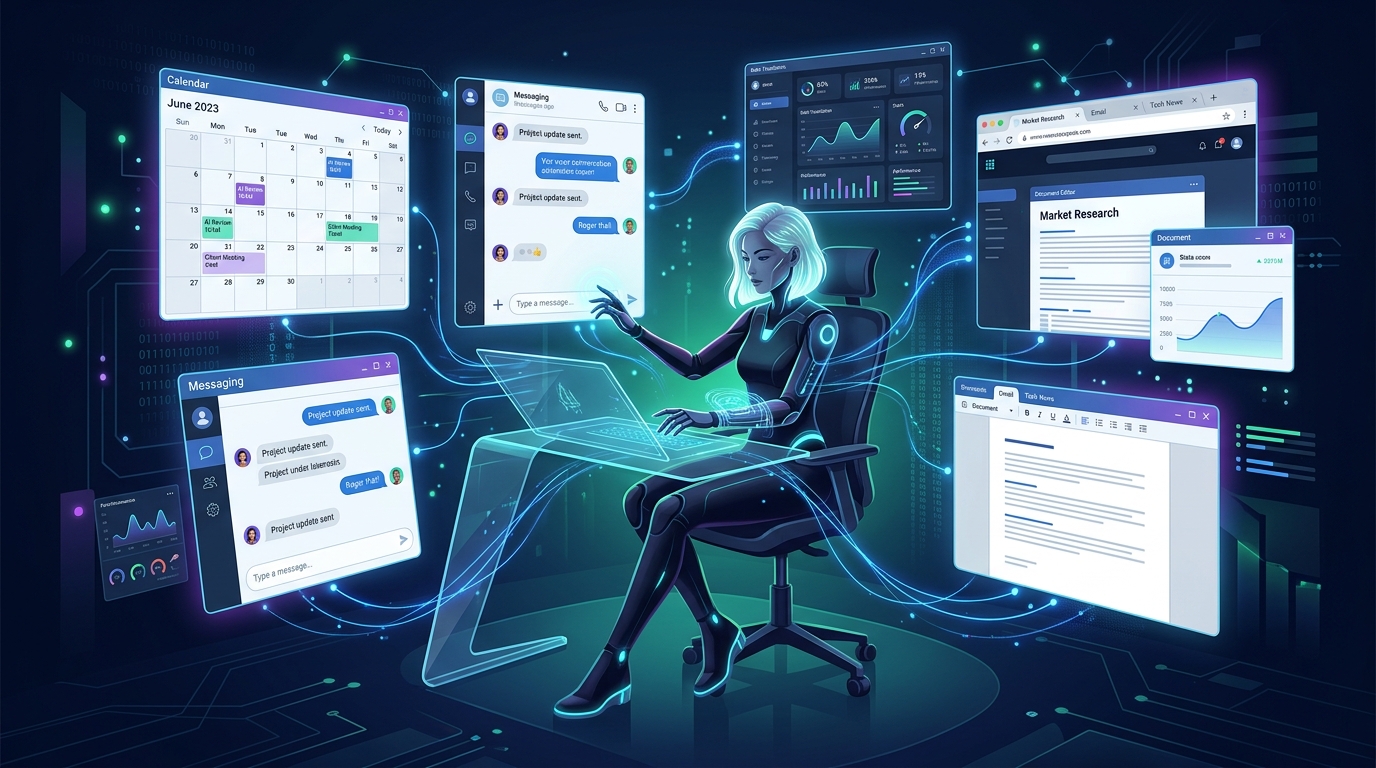
Enterprise automation in 2026 has crossed a critical threshold. The era of novelty prompt chains and brittle single-step API zaps has given way to robust agentic orchestration, deterministic schema contracts, and domain-specialized pipelines. Modern organizations are no longer asking whether AI can automate work—they are grappling with architectural trade-offs, maintenance economics, and reliability guardrails.
Automating high-volume business operations without an architectural framework creates technical debt faster than manual labor ever could. To provide technical leaders, systems architects, and operations directors with a definitive blueprint, The Indox AI Automation Guide examines four core tracks: evaluating economic viability, architecting deterministic vs. generative pipelines, building resilient orchestration workflows in n8n, and scaling vertical sector deployments across healthcare, QA testing, and agriculture.
Automation Focus Tracks & Strategic Blueprints
Audit & ROI Economics
Triage repetitive work, calculate true labor savings vs maintenance overhead
Deterministic vs. LLM Logic
Type-safe schema validation, avoiding hallucination traps in core data
n8n Enterprise Blueprints
Open-source orchestrations, automated resume screening & ad pipelines
Vertical Domain Deployments
Mission-critical systems: clinic patient triage, QA testing, AgTech robotics
Track 01: Audit & ROI Economics: Which Business Workflows Are Actually Worth Automating?
The most common failure in modern automation initiatives is automating tasks simply because the tooling makes it technically possible. An automation that takes forty engineering hours to construct, requires constant prompt re-tuning, and breaks whenever a third-party API changes is not an efficiency gain—it is an unbudgeted software maintenance liability.
Sustainable automation begins with rigorous triage. Workflows best suited for autonomous execution exhibit three characteristics: high frequency (occurring daily or hourly), predictable inputs and clear output expectations, and a well-defined tolerance for exception handling. Conversely, low-frequency strategic deliberations or bespoke client negotiations rarely yield positive ROI when automated.
Which Repetitive Work Inside a Business Is Actually Worth Automating?
A structured decision framework to categorize administrative tasks by operational frequency, error penalty, and net time savings.
Automations That Actually Save Time (And Ones That Don't)
Analyzing the maintenance overhead trap: why fragile multi-step zaps often consume more engineering attention than manual execution.
What Happens When AI Starts Doing Your Tasks?
Examining the psychological and structural shift when professionals move from manual execution to supervisory orchestration.
Track 02: Architecture & Reliability: Deterministic Pipelines vs. LLM Agentic Loops
A prevailing architectural misconception in 2026 is that every automated process requires an LLM. In reality, routing structured data through probabilistic models introduces latency, cost, and hallucination risks where traditional deterministic code performs flawlessly.
Production-grade enterprise architectures decouple deterministic processing (data extraction, arithmetic calculations, JSON schema validation, relational database operations) from probabilistic interpretation (semantic categorization, summarization, unstructured document parsing). By implementing strict type-safety contracts—such as the TypeSafe AI Jev methodology—teams ensure that generative outputs are coerced into strictly validated structures before downstream systems ever receive them.
Does Every Automation Need an LLM? A Look at TypeSafe AI Jev
Discover why leading enterprise engineering teams are pairing lightweight deterministic rule engines with type-safe schema validation to eliminate non-deterministic failure modes in mission-critical data pipelines.
Track 03: Modern Orchestration & n8n Enterprise Blueprints
While proprietary SaaS automation platforms (such as Zapier and Make) remain popular for basic integrations, enterprise technical teams have overwhelmingly pivoted toward self-hosted, node-based orchestrators like n8n. The advantages are compelling: on-premise execution ensuring data privacy and GDPR/HIPAA compliance, native execution of custom JavaScript/Python code within nodes, seamless vector database embeddings, and zero per-step execution licensing penalties.
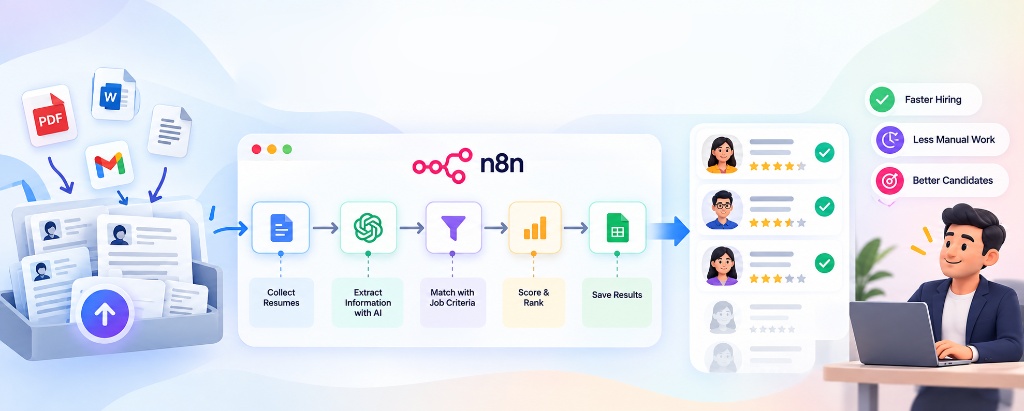
In high-volume workflows—ranging from dynamic ad copy optimization to automated recruitment screening—n8n provides the visual canvas needed to combine webhooks, document parsers, LLM evaluators, and relational persistence into reproducible production pipelines.
How to Automate the Meta Ads Workflow Using n8n + AI
Step-by-step implementation guide: connecting webhook triggers, generating audience-targeted ad copy variations with LLM models, and dispatching directly to Meta Marketing APIs.
How to Build an Automated Resume Screening Pipeline in n8n
Build a production candidate parsing pipeline: parsing multi-format resume files, extracting candidate competencies against rubric rubrics, and updating your ATS automatically.
Track 04: Mission-Critical Vertical Domains: Healthcare, QA & AgTech
When automation moves out of back-office marketing and into mission-critical operating environments, the penalty for systemic failure rises exponentially. In sectors like clinical patient triage, automated software verification, and precision agriculture, AI automation is not designed to replace practitioners—it functions as an operational force multiplier.
Across these diverse environments, successful implementations share common structural safeguards: human-in-the-loop verification checkpoints, audit logging for compliance mandates, and resilient fallback states when sensor feeds or model APIs degrade.
Why Clinic Workflows Break Down (And What Actually Helps)
Diagnosing administrative gridlock in outpatient facilities: identifying where manual paperwork creates patient bottlenecks and how structured digital intake eliminates delay.
How to Automate Patient Flow and Reduce Repetitive Work for Doctors
Implementing automated pre-consultation questionnaires, ambient documentation drafts, and intelligent appointment routing to save hours of physician administrative time.
How AI Can Help Manual Testers
Empowering quality assurance engineers: using generative models for synthetic test data creation, exploratory test-case matrix generation, and automated reproduction scripts.
Practical Ways AI Can Be Used in Agriculture
Field-tested AgTech deployments: computer vision crop disease diagnostics, drone-assisted yield mapping, and automated micro-climate irrigation controls.
2026 Enterprise Automation Archetype Matrix
Selecting the correct architectural archetype is crucial for balancing development velocity, operational cost, and system reliability. The table below compares the four primary paradigms deployed across enterprise organizations in 2026:
| Architecture Archetype | Core Tooling | Latency Profile | Hallucination Risk | Optimal Business Application |
|---|---|---|---|---|
| Deterministic Rule Engines TypeSafe Schemas | TypeScript / Jev | < 15 ms | Zero (0%) | Financial accounting, tax calculation, access control, audit compliance |
| Low-Code Orchestration Node Webhooks | n8n / Make | 100 - 500 ms | Zero (Code only) | CRM data syncing, transactional messaging, cross-app webhook routing |
| Hybrid LLM Pipelines Schema Extraction | n8n + Claude/GPT | 800 - 2,500 ms | Low (< 2% with schema) | Resume screening, customer support ticket triage, invoice data extraction |
| Autonomous Multi-Agent Multi-step Reasoning | LangGraph / CrewAI | 5,000 - 30,000 ms | Medium (Requires eval) | Deep research reports, multi-source competitive audits, complex code refactoring |
The 5 Golden Rules of Sustainable Enterprise Automation
Before committing engineering hours to building an autonomous workflow, ensure your architecture adheres to these five verified operational standards:
- 1. Enforce Strict Schema Validation Contracts Never feed unstructured natural language from an LLM directly into downstream relational databases or API endpoints. Always enforce strict JSON schemas (using Pydantic, Zod, or TypeSafe schemas) to coerce and reject malformed outputs at the perimeter.
- 2. Incorporate Human-in-the-Loop Circuit Breakers For actions that write permanent records, spend budget, or deliver client-facing communications, implement approval queues when confidence scores dip below defined thresholds (e.g., < 90%).
- 3. Decouple Orchestration from Model Providers Avoid hardcoding proprietary model SDKs directly into business logic. Utilize abstraction layers (LiteLLM, OpenRouter, or native n8n AI connectors) so you can switch between Anthropic, OpenAI, or local Ollama models without re-architecting your pipelines.
- 4. Implement Exponential Backoff and State Idempotency Third-party APIs and foundation model endpoints suffer intermittent rate limits. Build idempotent webhooks that can be retried multiple times without generating duplicate entries, charges, or notification emails.
- 5. Account for True Maintenance Cost in ROI Calculations Calculate your automation ROI as: (Hours Saved × Labor Rate) − (Setup Engineering Cost + Ongoing API Tokens + Monthly Monitoring Hours). If the formula does not break even within 90 days, reconsider manual or lightweight semi-automated execution.
Frequently Asked Questions
Key clarifications and practical answers addressed by The Indox editorial board.
How do we decide between Zapier, Make, and self-hosted n8n?
For rapid non-technical prototypes with under 1,000 tasks/month, Zapier or Make offers quickest time-to-market. For enterprise environments requiring data residency (GDPR/HIPAA compliance), custom JavaScript/Python execution, complex branching, or large-scale document parsing without steep per-step billing, self-hosted n8n is the industry standard.
What is the most reliable way to prevent LLM hallucinations in automated pipelines?
Pair temperature-zero prompting with structured JSON outputs and schema validation libraries. Reject any response failing the schema, prompt the model with the exact validation error for self-correction, and fall back to human review if validation fails twice.
Can automated workflows handle sensitive clinical or financial records?
Yes, provided the entire stack adheres to data isolation standards: self-hosted orchestration instances, zero-retention enterprise API agreements with model providers, encrypted data at rest, and role-based access control (RBAC) with detailed audit logging.