

Every month, a municipal housing authority or regional social services department receives thousands of applications for emergency rent relief, disability support, or public benefits. The intake process is labor-intensive: caseworkers open applications, verify identification documents, query legacy tax and property databases, calculate household income against statutory thresholds, request missing paystubs, route files to specialized review tiers, and log formal determinations.
When software vendors approach public agency leaders, the pitch is seductive: deploy an artificial intelligence pipeline to automate document triage, cross-reference databases, calculate risk scores, and process applications in seconds.
Yet in public administration, speed is never the sole measure of success. The defining question for a government institution is not simply: Can an algorithm process files faster? The far more urgent questions are constitutional, legal, and operational:
- What specific databases is the system querying, and are those records accurate and up to date?
- What is the software permitted to decide automatically, and what is strictly a recommendation for staff?
- When an algorithm flags an applicant for potential fraud, does the caseworker have the time, source evidence, and explicit authority to override it?
- If a citizen is denied a critical public benefit based on an automated finding, do they receive a plain-language explanation and an accessible appeal channel?
- Who within the agency possesses the formal authority to shut the system down when errors occur?
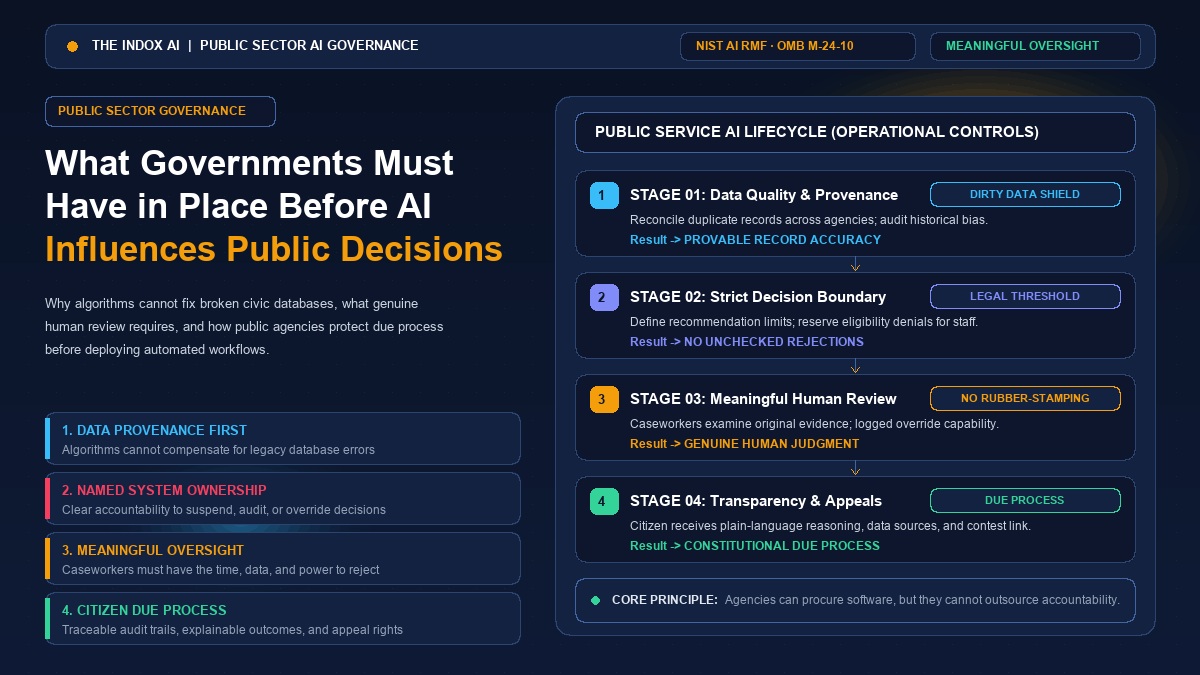
The central reality of public-sector technology is straightforward: algorithms cannot compensate for unreliable data, ambiguous accountability, weak human oversight, or poorly designed institutions. Good governance is not a policy document written after deployment. It is the concrete set of operating controls, decision boundaries, data verifications, and appeals mechanisms that govern how the system is allowed to function in the first place.
Moving Beyond Buzzwords to Operational Reality
Discussions of public-sector technology frequently drown in abstract rhetoric: "trustworthy AI," "ethical frameworks," and "algorithmic transparency." While well-intentioned, these phrases are useless to a civil servant unless translated into specific operational practices.
Consider how abstract principles map directly into everyday government workflows:
| Abstract Principle | What It Actually Means in a Public Workflow |
|---|---|
| "Accountability" | A named public official has legal responsibility for the system, reviews error logs, and has the authority to suspend operations immediately if an anomaly is detected. |
| "Transparency" | An affected citizen receives a plain-language notice stating that an automated system assisted the decision, citing the exact records used and providing instructions on how to contest the outcome. |
| "Human-in-the-Loop" | Caseworkers have dedicated time, full access to source evidence, and explicit protection against retaliation when they override an algorithmic recommendation. |
| "Data Quality" | Records pulled from upstream property, tax, or court databases are verified for freshness, reconciled across agency silos, and audited for legacy data entry errors. |
When governance is defined by operational criteria rather than aspirational slogans, public institutions can systematically evaluate whether a proposed system is safe to deploy.
Why Data Architecture Precedes the Model
A pervasive misconception among public-sector leadership is that deploying a modern language model or machine learning classifier will magically resolve decades of municipal data fragmentation.
In reality, public-sector data is notoriously fragmented. It lives across 1980s mainframe databases, siloed municipal spreadsheets, unindexed scanned PDF repositories, and disconnected state registries. Consider what happens when an automated eligibility screening pipeline queries these sources:
- Address and Identity Mismatches: A resident who moved six months ago has an updated address in the motor vehicle database, but a legacy property tax database still lists their previous residence. An automated fraud filter flags the application as "deceptive identity."
- Conflicting Field Definitions: Department A defines "household income" as gross earned wages, while Department B defines it as adjusted net taxable income. Feeding both datasets into an automated model produces inconsistent eligibility calculations.
- Missing Historical Data: An older database never captured whether an applicant's contract work was seasonal or full-time. The model interprets the blank field as zero income or unverified employment.
In our technical breakdown of the data engineering foundations underneath reliable AI systems, we demonstrated that models are strictly downstream from data pipelines. A sophisticated neural network or language model processes bad data with extraordinary speed and false confidence. If the underlying civic databases are plagued by duplicate records and stale timestamps, automation simply accelerates the distribution of unfair decisions.
Meaningful Oversight vs. Algorithmic Rubber-Stamping
Almost every public-sector AI policy mandates "human-in-the-loop" oversight. But in practice, human oversight is often completely illusory.
Consider an agency caseworker tasked with reviewing 60 benefit applications per day. If an automated triage tool pre-screens each file and marks 55 of them with a green checkmark labeled "Recommended: Approved" and 5 with a red warning labeled "Recommended: High Risk," what actually happens?
Because the caseworker has only eight minutes per case and is measured on processing throughput, cognitive ergonomics take over. This psychological phenomenon—known as automation bias—causes human operators to unconsciously defer to automated recommendations. If an employee is penalized for delays, lacks access to the underlying raw database records, or risks administrative reprimand for overturning an algorithm's fraud flag, they will rubber-stamp the software’s output 99% of the time.
The Five Pillars of Genuine Human Oversight
- Protected Review Time: Workload quotas must account for the time required to independently evaluate flagged evidence.
- Full Evidentiary Visibility: Caseworkers must see the exact underlying database records and reasoning chain, not an opaque summary score.
- Failure Mode Training: Reviewers must be trained on how the model fails, where historical data is incomplete, and common false-positive triggers.
- Institutional Discretion: Staff must have explicit statutory authority to override algorithmic flags without fear of penalty.
- Override Audit Logging: Every caseworker override must be recorded and fed back into operational audits to identify systemic model errors.
Risk Stratification: Proportional Governance in Practice
One of the primary errors in government technology planning is treating every automated tool as equally dangerous—or equally benign. Sound public-sector governance frameworks, such as the NIST AI Risk Management Framework (AI RMF 1.0) and the U.S. Office of Management and Budget’s OMB Memorandum M-24-10, require governance to scale with the consequence of error.
- Summarizing public meeting minutes for civil servants.
- Translating informational brochures into multiple languages.
- Public-facing chatbots answering static DMV operating hours.
- Drafting internal administrative correspondence for human editing.
- Semantic search indexing of published statutory regulations.
- Evaluating eligibility for public housing, food, or disability aid.
- Risk-scoring individuals for fraud audits or tax penalties.
- Prioritizing child welfare or family court investigative visits.
- Influencing municipal zoning, licensing, or commercial permits.
- Law enforcement resource allocation or bail recommendations.
When an application directly influences an individual’s rights, liberty, financial livelihood, or access to essential public services, the institution must implement rigorous due-process safeguards before a single real citizen’s record enters the pipeline.
The Pre-Deployment Institutional Checklist
Before an automated system begins influencing live casework, an agency must be able to answer seven foundational questions in plain language:
- Legal Authority & Clear Purpose: What specific statutory mandate authorizes the use of this tool, and what exact operational bottleneck is it designed to solve?
- Data Provenance & Freshness: Where did the underlying data originate, how frequently is it refreshed, and are legacy data silos audited for duplicate and conflicting records?
- Strict Decision Boundaries: What can the system recommend versus what can it execute? Does the system possess the technical ability to issue an automated denial? (Under best practices, automated rejections of rights-impacting services should be strictly prohibited).
- Adversarial & Edge-Case Testing: How was the system evaluated against non-standard cases—such as low-income gig workers with variable income streams, applicants with non-English names, or unhoused individuals without permanent addresses?
- Named Operational Ownership: Who is the designated official with operational accountability for the system, and who holds the authority to suspend it if error rates spike?
- Citizen Due Process & Redress: Does the citizen receive plain-language notice of automated involvement, an explanation of the specific data points used, and an accessible administrative appeal path?
- Audit Trails & Retrievability: Is every algorithmic recommendation, model version, prompt hash, and caseworker override immutably logged for independent oversight and judicial review?
Public Procurement: You Cannot Outsource Accountability
Most government agencies do not train custom foundation models; they procure commercial software-as-a-service (SaaS) platforms, proprietary decision systems, or systems-integration consulting contracts.
However, a government agency cannot outsource its legal and constitutional obligations to a third-party vendor. If a proprietary algorithm denies an eligible family food assistance due to a flawed statistical model, the agency—not the software vendor—is accountable under administrative law.
Public procurement contracts must enforce strict operational constraints:
- Prohibition on Model Training on Citizen Records: Citizen personal information (PII) processed by the system must never be retained, shared, or used to fine-tune external commercial models.
- Sovereign Data Residency: All data in transit and at rest must reside within approved government cloud enclaves adhering to rigorous security baselines (such as FedRAMP High or StateRAMP in the United States).
- Full Algorithmic Audit Rights: Contracts must grant the agency and independent public auditors complete access to training methodology, evaluation benchmarks, and source code where necessary, eliminating "black-box" proprietary trade-secret shields.
- Vendor Lock-In Protection: The agency must retain full ownership of all data, audit logs, and workflow recipes, ensuring it can migrate to an alternative platform or resume manual operations without disruption.
A Concrete Failure Scenario: The Case of the Heating Grant
To understand why governance is an operational necessity rather than a compliance exercise, examine this realistic hypothetical scenario:
Hypothetical Case Study: The Municipal Winter Energy Assistance Program
A mid-sized city deployed a commercial automated screening tool to accelerate processing for its low-income home heating assistance grant. To prevent fraud, the software cross-referenced incoming utility bills against municipal property tax registries and postal address databases.
An elderly homeowner who had lived in the same residence for forty years applied for emergency heating fuel. In the city’s 2004 property tax database, the home was recorded as "142 Oak Street." On the resident’s current heating utility bill, the address was formatted as "142 Oak St, Apt 1." The automated screening tool calculated an "Address Discrepancy Score" of 92% and assigned the file a red flag: "Suspected Commercial Property Sub-Lease / Ineligible."
An overworked caseworker, processing 75 cases an hour under strict departmental speed quotas, saw the red flag and clicked "Reject." The automated system mailed a standardized form letter stating only: "Your application has been denied due to inconsistent verification data."
The resident’s heating was shut off in January. It took three months, pro bono legal aid representation, and a formal administrative appeal to uncover that the "fraud" was nothing more than an address abbreviation discrepancy in a twenty-year-old municipal database.
Notice how completely this failure illustrates the absence of governance:
- The underlying database was outdated and lacked canonical normalization.
- The caseworker was pressured by throughput metrics and lacked time to investigate the source discrepancy.
- The citizen received an opaque denial letter with no plain-language explanation of what data triggered the rejection.
- There was no simple, rapid administrative channel to correct a minor clerical error before harm occurred.
Deterministic Rules vs. AI: Knowing When to Simplify
A crucial realization in public-sector modernization is that many government processes should not involve language models or statistical classifiers at all.
If eligibility for a municipal transit discount is defined by statute as: Resident is 65 years or older AND annual household income is below $34,000, that determination requires basic boolean arithmetic. It does not require a large language model. Writing a deterministic database query is faster, costs virtually nothing, and is 100% auditable.
As we explored in our operational guide on identifying repetitive work actually worth automating, the most effective improvement is often deleting an unnecessary bureaucratic step or fixing an outdated form rather than wrapping a bad process in artificial intelligence.
AI is valuable in public administration when dealing with unstructured information that genuinely requires language comprehension—such as summarizing 80-page environmental impact statements, routing free-form citizen inquiries to the correct municipal agency, or transcribing multilingual public hearings. In our guide to retrieval-augmented generation for enterprise knowledge bases, we detailed how contextual retrieval can assist civil servants in navigating thousands of pages of internal regulatory guidance—provided the human expert remains the decision-maker.
The Enduring Standard of Public Service
Government institutions bear a unique constitutional trust. Unlike private commercial enterprises, citizens cannot simply choose to take their business to an alternative provider if a public agency treats them unfairly. When a government makes a mistake, the consequences affect a person’s heat, housing, legal freedom, or family security.
By enforcing data provenance before model deployment, establishing meaningful human review with real authority to override, demanding vendor transparency, and guaranteeing robust citizen due process, public institutions can adopt technological tools that genuinely improve administrative delivery—without sacrificing the fairness, accountability, and humanity that lie at the heart of public service.
Master Architecture: Public sector AI governance and federal retrieval standards are charted in Track 4 of our 2026 AI Industry Tracker, examining sovereign infrastructure and citizen services.