
In 2026, building a functioning proof of concept for an AI application takes about forty-five minutes. A developer opens a Python notebook, loads twenty PDF documents, calls an embedding API, stores the vectors in an in-memory database, and wires up an LLM endpoint. They type a question, and within seconds, the model answers using context extracted from the files. It feels like magic.
Then that developer tries to deploy the prototype inside a company.
Suddenly, the notebook assumptions collapse against reality. The company does not have twenty clean PDFs stored in a local directory; it has 60,000 living documents scattered across Google Drive, Notion, Confluence, Jira, and PostgreSQL. Those documents change every morning. Employees delete obsolete files, but the old embeddings linger silently in the vector store. An ingestion job crashes halfway through, leaving 4,000 records half-indexed with no record of which files failed. A marketing coordinator asks a question and receives an answer citing unreleased executive compensation figures because the vector search has no concept of employee access tiers. When the model produces a hallucination, nobody can identify which document version or chunk offset generated the context.
At that point, the primary bottleneck is no longer calling a language model API or tuning a prompt. It is a data engineering, systems architecture, and operational hygiene problem.
Yet across the developer community, an overwhelming counter-narrative has emerged: elaborate roadmaps insisting that before touching an AI model, engineers must master a sprawling catalog of legacy and distributed technologies—Hadoop, Spark, Kafka, Kubernetes, Delta Lake, Iceberg, dbt, and multi-cloud infrastructure.
That advice is as misleading as the idea that AI requires no data engineering at all. Building an AI prototype and running a reliable production system are fundamentally different problems. But navigating that divide does not require learning every big-data technology ever invented. It requires understanding which data foundations matter early, which matter as systems scale, and which are specialized tools reserved for specific architectures.
The Three Tiers of Data Engineering for AI
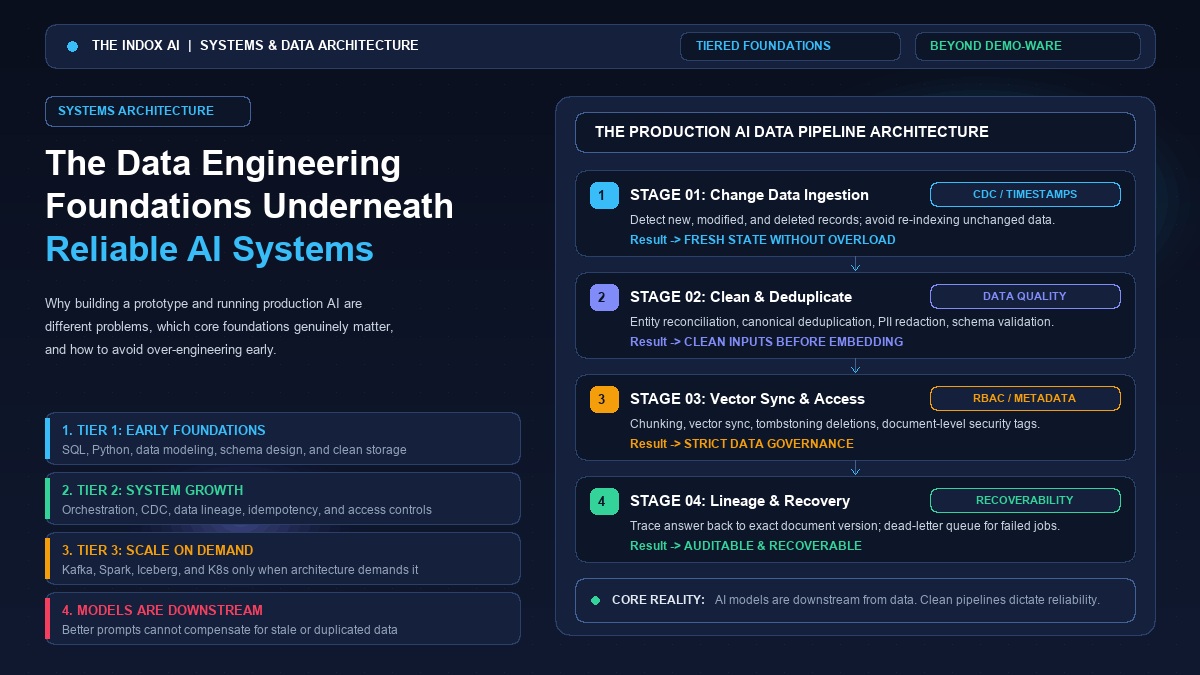
Rather than treating data engineering as a monolithic, six-month prerequisite, production-minded teams categorize skills into three distinct operational tiers:
| Tier | Core Technologies & Concepts | Why It Matters for AI Systems |
|---|---|---|
| Tier 1: Foundations to Learn Early | SQL, Python (typing, async), data modeling, schema design, basic Linux, HTTP/REST APIs, storage primitives. | Essential for structuring business inputs, querying relational vector stores, and building clean ingestion pipelines. |
| Tier 2: Skills That Matter as Systems Grow | Orchestration (Airflow/Dagster/Prefect), Change Data Capture (CDC), data lineage, Docker containers, monitoring, access control (RBAC). | Required when data changes continuously, pipelines need automated retries, and answers must be auditable and permissioned. |
| Tier 3: Specialized Tools for Scale | Apache Spark, Apache Kafka, Apache Iceberg, Delta Lake, Kubernetes, distributed stream processing. | Only needed when processing terabytes of multi-modal streams, sub-second event logs, or petabyte-scale lakehouses. |
Understanding this tiered progression prevents developers from falling into analysis paralysis. You do not need to install an Apache Spark cluster to build a dependable document assistant. But you do need to know how to write an idempotent SQL query.
Tier 1: The Non-Negotiable Foundations
When developers ask which traditional data skills transfer most directly to production AI, many expect esoteric mathematical algorithms. In reality, the most valuable skills are practical data mechanics:
1. SQL and Relational Modeling
SQL is not merely a tool for generating business intelligence dashboards. In modern AI architectures, SQL is the glue that binds vector embeddings to business reality.
Vector databases like PostgreSQL with pgvector, Supabase, or hybrid search engines rely on standard SQL to filter metadata, enforce user permissions, and perform hybrid ranking (combining keyword BM25 full-text search with vector cosine similarity). If an AI application cannot execute a query like:
FROM document_embeddings
WHERE organization_id = $org_id
AND access_roles && $user_roles
AND is_deprecated = false
ORDER BY similarity DESC LIMIT 5;
...then your retrieval layer will either leak confidential data or retrieve irrelevant, deprecated context. Knowing how to design normalized schemas, create composite B-tree and HNSW indexes, and handle JSONB attributes is foundational to making retrieval reliable.
2. Schema Validation and Defensive Typing
In a notebook tutorial, raw text flows loosely from function to function. In production, unvalidated text guarantees silent failures. An AI pipeline must enforce schema boundaries using libraries like Pydantic or Zod. Every document chunk entering a database must have explicit attributes: parent document ID, cryptographic content hash, chunk index, byte offset, source timestamp, and access permissions.
3. Storage Fundamentals
Engineers must understand the distinct operational tradeoffs between object storage (AWS S3, Cloudflare R2), relational transactional stores (Postgres, MySQL), and specialized vector indexes. Storing raw 50MB PDFs directly in a transactional database is an architectural antipattern; storing them in an object store while storing extracted, versioned text chunks and embedding vectors in a relational store is standard engineering practice.
The Anatomy of Production RAG: Where Tutorials End
Retrieval-Augmented Generation is where the gap between demo-ware and engineering is most visible. In our foundational breakdown of how retrieval-augmented generation bridges enterprise data with language models, we outlined the core conceptual loop: chunking, embedding, vector similarity, and contextual generation.
In a toy tutorial, that loop is static. You ingest documents once and query them. In a production business application, documents are dynamic living systems. Every production RAG system must solve five unavoidable data-engineering problems:
1. Change Data Capture (CDC) and Freshness
When a technical writer updates an API documentation page, how does the vector index know? Re-embedding an entire corporate corpus of 50,000 pages every night burns hundreds of dollars in API credits and creates massive compute overhead. Production pipelines track SHA-256 content hashes or source modified timestamps, re-indexing only the diffs.
2. Tombstoning and Hard Deletions
When a legal contract or deprecated security policy is deleted from the source repository, the pipeline must cascade that deletion to every corresponding chunk in the vector index. Failing to implement deletion handling means your AI assistant will happily cite revoked corporate policies months after they were discarded.
3. Canonical Deduplication
In any enterprise, the exact same PDF or announcement email exists in six different folders and mailboxes. If an ingestion pipeline ingests all six copies, a vector search for that topic will return five identical chunks, crowding out other relevant context from the LLM’s context window.
4. Lineage and Ground-Truth Citations
When a user asks: "Why did the assistant say our refund policy is 14 days?", the system must provide traceable data lineage: Source: ReturnPolicy_v3.pdf (Git Commit #8f2a1c), Chunk #4, Ingested 2026-03-12 04:00 UTC. Without deterministic lineage, debugging hallucinations is impossible.
Why AI Agents Inherit Ordinary Data Problems
The same operational reality applies to autonomous AI agents. Much of the industry excitement around agents focuses on reasoning loops, reflection prompts, and tool calling protocols like MCP (Model Context Protocol).
However, when an agent executes a workflow in a business context, what does it actually do? It calls tools:
- An agent resolving an e-commerce customer dispute calls
get_order_status(order_id). - An agent booking a flight checks inventory availability and billing status.
- An agent generating an executive briefing pulls quarterly sales numbers from an analytics database.
If the underlying data warehouse has dirty records—where one customer has three conflicting account IDs, payment statuses fail to synchronize across microservices, or inventory records lag by four hours—the agent will make decisions based on false premises.
As we explored in our analysis of what happens when AI begins executing tasks autonomously, delegating real-world actions to language models magnifies data quality issues. A human employee might notice that an inventory count of -15 is impossible and ask a colleague. An autonomous agent will either crash or attempt to process the order anyway. Clean APIs, idempotent write endpoints, and verified schemas are the prerequisites for reliable agentic actions.
Data Quality in Plain English: Models Are Downstream
A common trap for software teams new to AI is trying to solve data quality problems with prompt engineering.
When an assistant returns outdated instructions, engineers spend days tweaking system prompts: "You are a helpful assistant. Make sure you only use the newest policy. Carefully check dates."
This is an exercise in futility. If your retrieval system pulls two conflicting documents into the context window—one from 2022 stating that travel expenses require VP approval, and one from 2025 stating that director approval is sufficient—you are forcing a probabilistic language model to guess corporate intent.
The Golden Rule of AI Data Flow
The language model is downstream from your data pipeline. Better prompts cannot compensate for dirty schemas, unmerged duplicates, or stale indexes. If you fix the data upstream, you don't have to plead with the model downstream.
Tier 2: Orchestration, Observability, and Failure Recovery
As an AI application moves from a developer's machine to a shared environment, it encounters the realities of distributed systems: network partitions, third-party API rate limits, schema drift, and server restarts. This is where Tier 2 data engineering skills become vital.
Workflow Orchestration and Idempotency
Running an ingestion script with a local cron job is fine for a personal hobby project. In production, document ingestion pipelines require structured workflow orchestrators—such as Apache Airflow, Prefect, Dagster, or event-driven workflow engines.
In our operational deep dive on evaluating business workflows and preventing maintenance drag, we examined why fragile automated scripts collapse under unexpected exceptions. A robust orchestrator provides:
- Automatic Retries with Exponential Backoff: If an embedding provider returns a 429 Rate Limit or 503 Gateway Timeout, the pipeline backs off safely without dropping data.
- Idempotency: If a job processing 10,000 files fails at file 8,400, re-running the pipeline should not create duplicate embeddings for the first 8,399 files. It should resume cleanly from the point of failure.
- Dead-Letter Queues (DLQ): If an unreadable, corrupted PDF crashes a text parser, that specific record is quarantined into an exception table with an error log, allowing the remaining 9,999 documents to complete processing.
Granular Governance: Metadata-Gated Security
In enterprise AI, data security cannot be solved by simply running multiple isolated vector databases for every single department. That creates operational chaos and duplicate infrastructure costs.
Instead, production architectures use Metadata-Gated Retrieval. Every document ingested inherits access control attributes from its parent system:
When an employee submits a query, the retrieval layer attaches their authenticated identity tokens directly to the vector database query filter. If a user does not possess the finance_analyst role, chunks tagged with that clearance are mathematically excluded before similarity ranking occurs.
Tier 3: When Do You Actually Need Big Data Tools?
Much of the intimidation surrounding data engineering stems from conflating foundational data engineering with hyperscale distributed infrastructure.
Online roadmaps frequently tell developers that to build AI systems, they must master:
- Apache Spark: Do you need Spark? Only if you are transforming terabytes of tabular data across hundreds of distributed compute nodes. If your company’s entire documentation corpus fits in 50 gigabytes, running Spark adds massive operational complexity without benefit. A clean Python pipeline using DuckDB or Polars will process the data in seconds on a single server.
- Apache Kafka: Do you need Kafka? Only if you are building an event-driven streaming architecture handling hundreds of thousands of events per second. If your documents update on hourly or daily schedules, a robust batch queue (like Celery, BullMQ, or an orchestrator DAG) is simpler, cheaper, and far easier to maintain.
- Apache Iceberg & Delta Lake: Do you need lakehouse table formats? Only if you are managing petabyte-scale analytical data lakes stored on cloud object storage that require ACID transactions and time-travel querying across distributed query engines (Trino, Athena, Snowflake).
- Kubernetes: Do you need K8s clusters? Only if your organization runs dozens of microservices with complex auto-scaling requirements. If you are deploying an internal AI service, managed container platforms (like AWS ECS, Google Cloud Run, or simple Docker Compose setups) provide 95% of the benefits with a fraction of the operational overhead.
The hallmark of an experienced systems engineer is not how many complex tools they deploy. It is selecting the simplest architecture that solves the problem reliably.
A Practical Project: The Evolution of an Internal Knowledge Assistant
To connect these disciplines without feeling overwhelmed, the best path forward is to build a single AI project and progressively solve its emerging data engineering bottlenecks:
Build a local Python script using LangChain or LlamaIndex. Load 10 markdown files, generate embeddings, store them in Chroma, and query them with an LLM. Verify that basic semantic retrieval works.
Migrate from in-memory storage to PostgreSQL with pgvector. Write a synchronization script that computes SHA-256 hashes of input files. Only embed files whose hash has changed since the last run. Implement deletion handling (if a source file disappears, delete its chunk records).
Add metadata columns to your PostgreSQL table: department, allowed_roles, and document_version. Modify your retrieval query so that every vector similarity search applies a SQL WHERE filter based on the simulated logged-in user’s permissions.
Wrap the ingestion pipeline into an orchestrator DAG (such as Prefect or an n8n workflow). Add retry policies with exponential backoff for embedding API timeouts. Create a dead-letter quarantine table for corrupted documents that fail parsing.
Log every query, retrieved chunk ID, cosine similarity score, and model response latency. Format the assistant’s output so every claim cites the exact document title, section heading, and last-updated timestamp.
By the time you complete Phase 5, you have not merely built an AI demo. You have built a production-grade information system that can survive real-world corporate data.
The Realistic Learning Path
If you are a developer, software engineer, or aspiring data practitioner looking to work on modern AI systems, do not let viral roadmaps convince you that you must study 1990s distributed database theory before touching an LLM.
The most effective learning progression is symbiotic:
- Master SQL, Python, and Relational Modeling: Learn how to store, query, join, and validate structured data cleanly.
- Build a Functional AI Application: Build a RAG service or tool-calling agent to understand how models consume context and where they stumble.
- Solve the Immediate Data Friction: Implement change detection, deduplication, schema validation, and access control on your existing application.
- Add Orchestration and Monitoring: Ensure your pipelines run reliably on a schedule, retry on transient network errors, and notify you when source schemas drift.
- Learn Distributed Tools Only When Scale Demands It: When—and only when—your data volume exceeds single-server memory and compute constraints, invest time in distributed engines like Spark, streaming brokers like Kafka, or cloud lakehouse formats.
Artificial intelligence has not made data engineering obsolete. It has made clean data engineering vastly more visible. When an application directly translates raw enterprise records into public-facing human language, every flaw, duplicate, and stale record in your data pipeline is laid bare. By mastering the core data foundations—whether engineering telemetry for practical AI applications in agriculture or scaling enterprise search—you build systems that move beyond fragile demonstrations and deliver dependable, enduring value in the real world.
Master Architecture: Core data infrastructure and embedding synchronization are analyzed in Track 4 of our 2026 AI Software Engineering Playbook, establishing backend foundations for production AI applications.