
Across the technology landscape, artificial intelligence is often marketed to agriculture through sweeping, futuristic promises: fully autonomous robotic swarms tending thousand-acre fields, satellite algorithms eliminating crop losses overnight, and automated yields that magically double without human intervention.
For experienced growers, farm managers, and agricultural engineers, these grandiose pitches fall flat. Farming is not an idealized software sandbox; it is an unforgiving physical discipline defined by unpredictable weather, high capital stakes, dust, equipment vibration, and razor-thin operating margins. An algorithm that works in a controlled research greenhouse frequently falls apart when exposed to real-world field conditions.
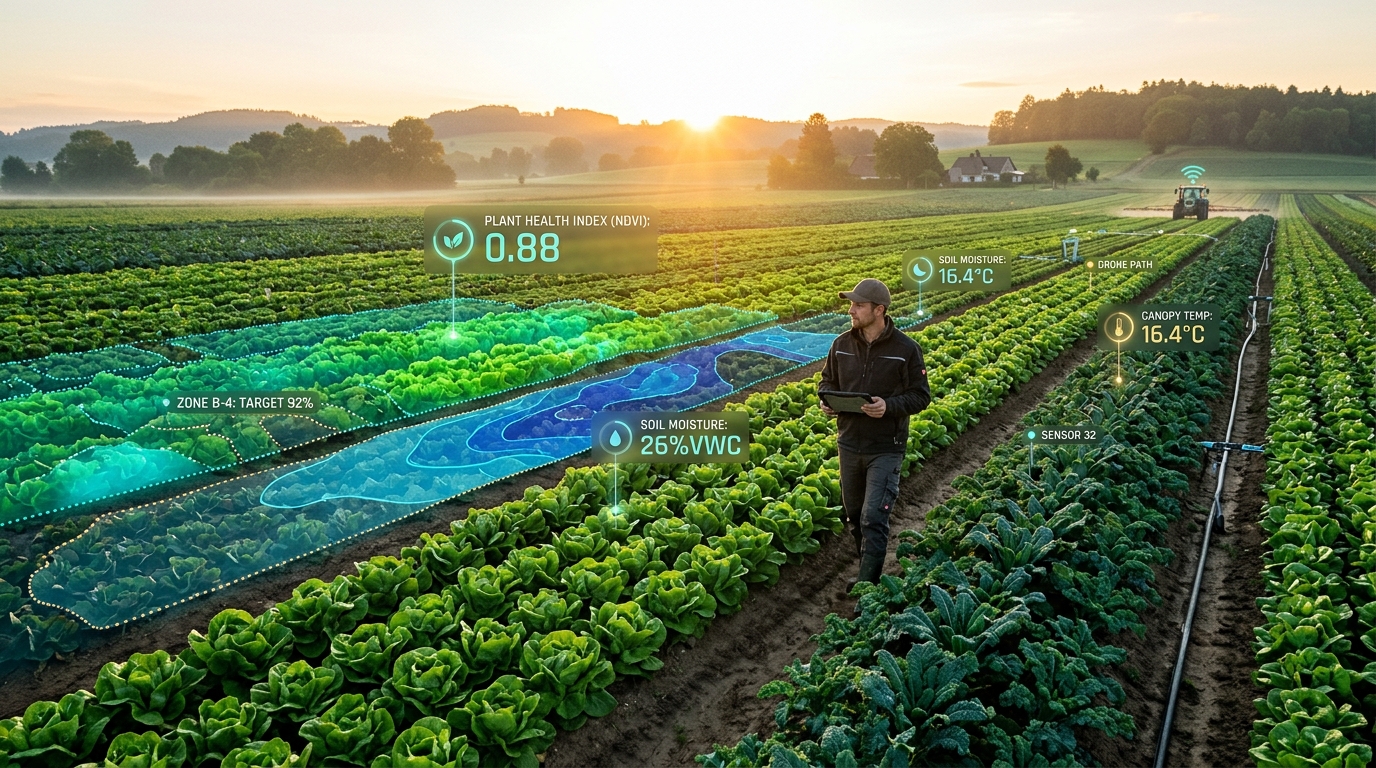
Yet away from the hype, a quiet transformation is taking hold. When designed around specific, well-bounded agronomic challenges, artificial intelligence is proving to be a genuine force multiplier. The central value of modern ag-tech AI is straightforward: it helps farmers spot problems earlier and make informed decisions on where to act.
Here are five practical ways AI is being actively deployed in agriculture today—backed by recent field implementations, tangible operational benefits, and the realistic boundaries every grower should understand.
| Agricultural Application | Core Operational Problem | Real-World Solution & Milestone | Key Limitation & Human Role |
|---|---|---|---|
| 1. Crop Disease & Pest Diagnosis | Delayed identification of leaf lesions, blight, or pest infestations. | Digital Green FarmerChat V2 (Multimodal CV + Extension RAG) | Image quality varies; photo recommendations require field scouting before chemical spray. |
| 2. Canopy Water Stress Modeling | Rigid irrigation schedules that overwater saturated zones and miss stressed blocks. | CropX Vision (Smartphone canopy vision launched March 2026) | Calibrated for vineyard canopies; cannot be applied to row crops without regional tuning. |
| 3. Precision Weed Spot-Spraying | Broadcast herbicide spraying wasting chemicals on bare soil. | John Deere See & Spray Gen 2 (Millisecond edge nozzle actuation) | Requires compatible self-propelled sprayers, boom stabilization, and lens maintenance. |
| 4. Dairy Herd Disease Risk Prediction | Subclinical mastitis and ketosis go undetected until production drops. | DeLaval Plus (US launch Sept 2026, predictive health models) | Provides risk stratification for triage; does not replace veterinary clinical diagnosis. |
| 5. Operational Telemetry Assistant | Agronomic, yield, and machine telemetry trapped in disparate PDF reports. | John Deere JD AI Assistant (Operations Center RAG, announced Sept 2026) | Dependent on consistent sensor logging, implement calibration, and clean field boundaries. |
1. Identifying Crop Diseases and Pests from Field Photographs
One of the most immediate challenges for smallholders and commercial farm managers alike is diagnosing plant pathology under time pressure. When early blight, rust, powdery mildew, or fall armyworm first appear in a field, the initial symptoms are subtle—tiny necrotic spots, slight leaf discoloration, or irregular chewing patterns along leaf margins.
Traditionally, diagnosing these symptoms required waiting days for an agricultural extension agent to visit or sending physical tissue samples to a university lab. By the time lab results returned, the pathogen had often spread across hundreds of acres.
Modern computer vision models trained on curated botanical datasets (such as PlantVillage and regional agricultural institute archives) allow growers to capture a smartphone photograph of an affected leaf and receive immediate diagnostic guidance. A prominent real-world example is Digital Green’s FarmerChat, an open-source and multilingual AI advisory system built in partnership with agricultural ministries across South Asia and Sub-Saharan Africa.
Following its major V2 update on July 9, 2026, FarmerChat integrated multimodal computer vision with conversational retrieval, allowing farmers to submit photos alongside voice notes in local dialects. September 2026 research from the engineering team demonstrated how lightweight vision models can overcome messy, uncurated field photography—filtering out background soil clutter, partial hand occlusion, and inconsistent sunlight glare to isolate symptomatic leaf tissue.
The Practical Boundary
A smartphone photo provides a diagnostic hypothesis, not a definitive laboratory confirmation. Pathogen lookalikes (such as nutrient deficiencies that mimic viral chlorosis) can easily mislead image classifiers. Growers should treat photo-based AI outputs as an alert to conduct physical field scouting and consult local agronomic guidelines before ordering expensive chemical sprays.
2. Making Precision Irrigation Decisions from Plant Canopy Stress
Water management in irrigated agriculture has historically relied on rigid calendar schedules or broad regional evapotranspiration estimates. While soil moisture probes provide accurate depth readings, installing and maintaining underground telemetry sensors across every micro-zone of an orchard or vineyard is prohibitively expensive.
As explored in our deep-dive on the data engineering foundations underneath reliable AI systems, telemetry models are only as dependable as the consistency and quality of their input pipelines. In precision viticulture, computer vision is bridging this gap by measuring how plants physically manifest moisture deficit.
On March 24, 2026, ag-tech platform CropX announced the global commercial rollout of CropX Vision. Available on iOS and Android, the system enables vineyard managers to photograph grape canopies with standard smartphone cameras. Computer vision algorithms evaluate leaf angles, canopy density, and petiole wilting against calibrated agronomic stress indices.
By combining canopy imagery with ambient weather telemetry and root-zone sensor data, the platform estimates leaf water potential without requiring growers to hike through vines carrying delicate, manual Scholander pressure chambers. This allows vineyard operators to apply targeted deficit irrigation—preserving precious groundwater while optimizing berry size and sugar concentration for winemaking.
Where human judgment is essential: CropX Vision was meticulously calibrated for grapevine morphology. Attempting to generalize the same computer vision pipeline to broadacre crops like corn or cotton without dedicated crop-coefficient training would produce misleading results. Growers must balance AI canopy stress estimates against physical soil texture, root depth, and upcoming heatwave forecasts.
3. Targeted Weed Control with Millisecond Computer Vision Spraying
In conventional broadacre farming, weed management has long been an exercise in blanket application. A self-propelled sprayer with a 120-foot boom drives across a fallow field or emerged crop at 15 miles per hour, broadcasting herbicide across every square inch of the field—even if weeds only occupy 10% to 15% of the total soil surface.
This uniform broadcasting wastes millions of dollars in chemical inputs, accelerates herbicide resistance, and introduces unnecessary environmental runoff. In our analysis of automations that actually save time versus ones that create maintenance headaches, high-value agricultural automation succeeds when it directly solves high-cost operational bottlenecks.
Machine-vision targeted spraying is perhaps the most commercially mature example of this principle. Systems like John Deere See & Spray deploy dozens of ruggedized high-resolution cameras along the length of the sprayer boom. As the machine travels at field speed:
- Edge Inference: Onboard GPU processors run optimized deep learning vision models, differentiating emerging cash crops (such as soybeans or corn) from invasive weed species within 30 milliseconds.
- Targeted Actuation: Pulse-width modulation (PWM) solenoid valves open only above the identified weed, delivering a precise burst of herbicide directly to the target.
- Chemical Reduction: Independent field trials and manufacturer data document herbicide savings between 50% and 75% compared to broadcast spraying.
With the current See & Spray Gen 2 architecture rolling out updates scheduled through 2026 and 2027 machine models, the system incorporates enhanced dual-tank configurations—allowing farmers to broadcast residual pre-emergent chemistry while spot-spraying non-selective contact herbicides in a single pass.
Much like determining which repetitive work is actually worth automating, targeted spraying demands substantial capital investment and meticulous maintenance. Lens cleanliness in dusty field conditions, boom stability calibration, and proper droplet size management remain critical operational responsibilities for the equipment operator.
4. Flagging Potential Livestock Health Problems Before Symptoms Escalate
In modern commercial dairy operations managing herds of 500 to 5,000 cows, monitoring individual animal health on a daily basis is a major operational challenge. Highly prevalent bovine conditions like mastitis (udder inflammation) and subclinical ketosis (metabolic energy deficit) can cause permanent tissue damage, degrade milk quality, and incur heavy antibiotic costs if caught late.
On September 22, 2026, dairy robotics leader DeLaval launched DeLaval Plus in the United States, introducing its AI-powered Disease Risk Predictions application. Rather than waiting for a cow to show overt clinical lethargy or abnormal milk clots, the system aggregates continuous telemetry from automated milking robots (VMS) and wearable sensor collars:
- Quarter-by-quarter milk conductivity and temperature spikes.
- Deviations in individual milking speed and peak milk yield.
- Rumination minutes and resting behavior tracked via IoT neck collars.
- Real-time milk composition indicators (fat-to-protein ratio shifts signaling early ketosis).
As explored in what happens when AI starts handling routine monitoring tasks, this shifts the herdsperson's role from reactive firefighting to proactive, scheduled intervention. Instead of walking entire barns guessing which animals might be struggling, the herd manager receives a prioritized morning triage list of high-risk cows.
The veterinary line: DeLaval Plus explicitly generates risk probabilities, not clinical veterinary diagnoses. An alert serves as a flag for the herdsman to perform a physical California Mastitis Test (CMT), check core body temperature, or inspect feed bunks. Autonomous software must never replace veterinary oversight when administering medication.
5. Turning Fragmented Farm Telemetry into Usable Operational Answers
Modern precision agriculture generates an overwhelming volume of digital data: as-planted seed hybrid maps, soil fertility grids, variable-rate fertilizer logs, combine yield telemetry, and fuel consumption rates. Yet for most operators, this data sits trapped in separate software dashboards, proprietary tractor monitors, and exported CSV spreadsheets.
When preparing for spring planting or winter equipment maintenance, a farmer rarely has the time to cross-reference five separate harvest maps to figure out why an 80-acre corner underperformed.
To tackle this data silo problem, John Deere unveiled the JD AI Assistant on September 1, 2026 at the Farm Progress Show, opening limited early access for select US agricultural customers within John Deere Operations Center.
Built using domain-adapted Retrieval-Augmented Generation (RAG), the assistant is grounded directly in the farmer’s own verified telemetry and machine history rather than generic internet training data. A producer can ask direct operational questions using conversational voice or text:
"Which corn hybrid delivered the lowest moisture content across our irrigated circles last fall, and how did fuel consumption compare between the S780 and S790 combines in Field 14?"
Within seconds, the assistant synthesizes agronomic yield maps, machine telematics, and operational logs into a succinct summary with direct links to the source field layers.
The data hygiene reality: The utility of any operational assistant is bounded by the quality of the underlying records. If an operator failed to calibrate combine yield sensors at the start of harvest, or if custom applicators didn't upload as-applied fertilizer files, the AI will either deliver incomplete answers or highlight data gaps. Clean data engineering remains the foundation of trustworthy farm intelligence.
The Golden Rule of Agricultural AI: Augmentation, Not Autonomy
Across pest identification, irrigation, weed spraying, livestock management, and telemetry analysis, a clear pattern emerges: the most effective agricultural AI tools do not attempt to replace the farmer.
Farming requires an intuitive understanding of micro-climates, soil biological health, commodity markets, and risk tolerance that no synthetic neural network can replicate. An AI model can count weeds at twenty miles per hour, flag a cow with elevated somatic cell potential, or estimate canopy water stress from a smartphone snapshot.
What it cannot do is evaluate whether rain next Tuesday will make spraying counterproductive, or whether a spike in fertilizer prices warrants adjusting this season's nitrogen targets. By treating artificial intelligence as a vigilant diagnostic companion rather than an infallible oracle, modern producers can cut operational waste, protect crop health, and make every hour in the field count.
Master Architecture: AgTech computer vision and autonomous field operations are examined in our 2026 AI Workflow Automation Guide, highlighting sensor-driven automation and real-world robotics.