Software engineering in 2026 has transformed from manual keystroke composition to architectural orchestration and rigorous verification. The widespread adoption of agentic coding environments, multi-model developer swarms, and autonomous terminal agents has dramatically accelerated output volume—while simultaneously multiplying the risk of silent regressions, architectural drift, and perimeter security vulnerabilities.
Building production-grade software with AI requires far more than pasting snippets into chat windows. The Indox AI Software Engineering Playbook provides engineering leads, architects, and senior developers with an end-to-end framework across four foundational tracks: optimizing agentic latency and developer ergonomics, architecting multi-agent collaboration rooms, implementing strict automated verification guardrails, and hardening data foundations and bot-resistant infrastructure.
Software Engineering Focus Tracks & Architecture Guides
Agentic Workflows & Speed
Realistic developer workflows, inference latency economics, flow-state optimization
Multi-Agent Swarms & Benchmarks
Shared agent chat rooms, memory protocols, testing frontier models like GPT-6.1 Sol
Verification & Production Testing
Sandboxed execution, automated property testing, catching hallucinations before deploy
Data Foundations & Edge Defense
Reliable data engineering for AI systems, diagnosing modern bot protection bypasses
Track 01: Agentic Workflows & Latency Dynamics: How Modern Developers Actually Ship Code
The initial era of AI coding—characterized by copying snippets back and forth between a web browser and an editor—is obsolete. Modern software development in 2026 relies on integrated agentic environments that possess full workspace context, understand dependency trees, and execute terminal commands natively.
However, practical engineering teams know that AI acceleration is non-linear. The bottleneck is rarely raw model intelligence; it is the ergonomics of feedback loops. When an AI coding assistant responds in under 800 milliseconds, developers remain in an unbroken cognitive flow state, treating the model as a fluid pair programmer. Conversely, when deep reasoning agents take 30 to 60 seconds to synthesize a patch, developers context-switch unless the agent is delegated complete asynchronous tasks with deterministic unit test checkpoints.
Writing Code With AI: A Realistic Workflow
Step beyond corporate demos to examine the daily reality of engineering with AI: prompt framing, test-first scaffolding, PR reviews, and managing codebase mental models.
Can Faster AI Responses Actually Speed Up Software Development?
Analyzing the relationship between inference latency, prompt caching throughput, and cognitive context switching across enterprise software development squads.
Track 02: Multi-Agent Collaboration & Frontier Benchmarking
As software projects exceed the cognitive window of a single AI context session, the industry has migrated toward multi-agent coordination architectures. Rather than asking a single general-purpose model to architect, implement, refactor, and write security tests simultaneously, specialized agents collaborate across shared protocol rooms.
In this architecture, an Architect Agent establishes module interfaces and type contracts; an Implementation Agent writes the function bodies; and an independent Adversarial Review Agent attempts to find memory leaks, SQL injection vulnerabilities, and broken edge cases. Navigating this paradigm requires understanding agent inter-communication protocols and stress-testing frontier coding models on real production workloads.
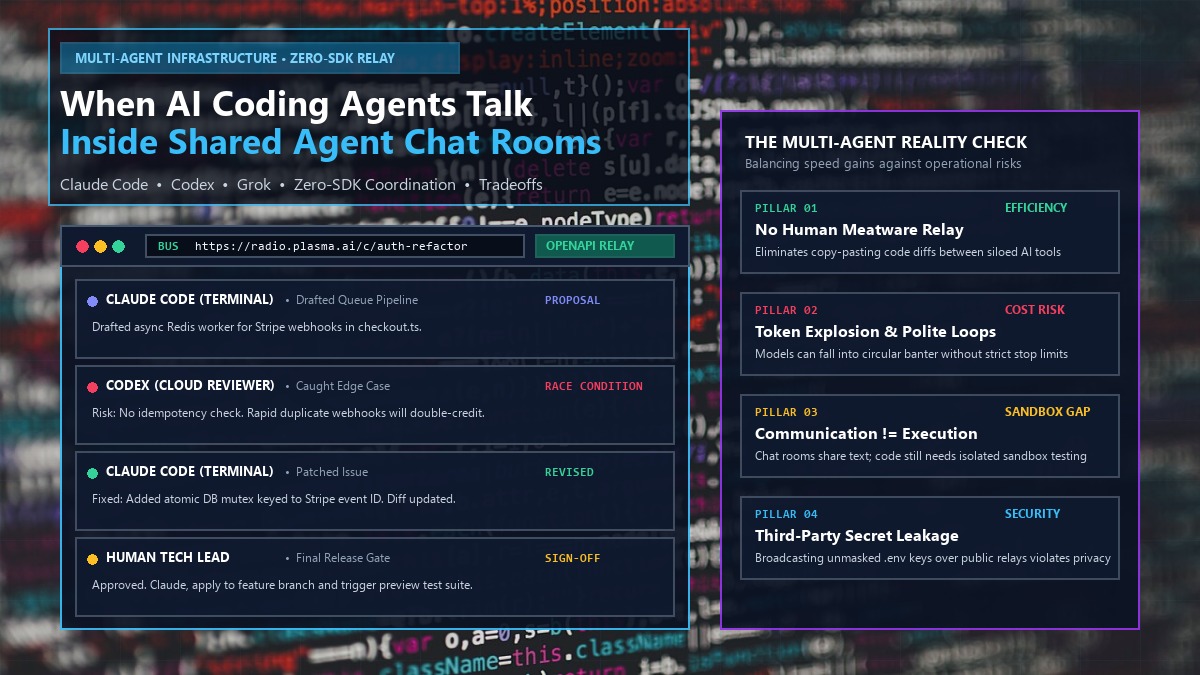
When AI Coding Agents Talk to Each Other: Inside the Push for Shared Agent Chat Rooms
An architectural investigation into shared agent memory busses, peer-to-peer task handoffs, and preventing catastrophic drift when autonomous agents communicate without human mediation.
How to Test GPT-6.1 Sol on Real Coding and Automation Tasks
Practical testing protocols for evaluating next-generation frontier reasoning models on messy legacy codebases, complex migrations, and multi-file refactoring tasks.
Track 03: Verification, Testing & Production Guardrails
The fundamental rule of engineering with AI is simple: Never trust unverified machine output in production. AI models generate code that looks convincingly correct at first glance, but may introduce subtle concurrency deadlocks, hallucinated library arguments, or unhandled null exceptions that only manifest under production loads.
Production-ready engineering pipelines employ automated verification rings: isolated Docker sandboxes that compile and run code against unit and integration suites, static linters that enforce corporate style rules, property-based testing suites that fuzz boundary inputs, and automated staging preview environments before any branch is eligible for merge.
How to Test AI-Generated Code Before It Reaches Your Live Website
A complete technical testing checklist: setting up ephemeral preview containers, automated visual regression sweeps, and security vulnerability scans to intercept flawed AI code before live deployments.
Track 04: Data Infrastructure & Edge Security: Foundations Underneath Reliable AI
Behind every high-performing AI application lies a resilient data engineering foundation. If an AI system relies on stale vector indexes, unvalidated retrieval pipelines, or inconsistent relational databases, the finest prompting techniques in the world will fail to prevent degraded user experiences.
Simultaneously, engineering teams must protect their applications from unauthorized automated exploitation. The explosion of AI agents has created an unprecedented wave of autonomous scraping bots capable of bypassing basic rate limiters and browser fingerprints—demanding multi-layered edge security and behavioral telemetry analysis.
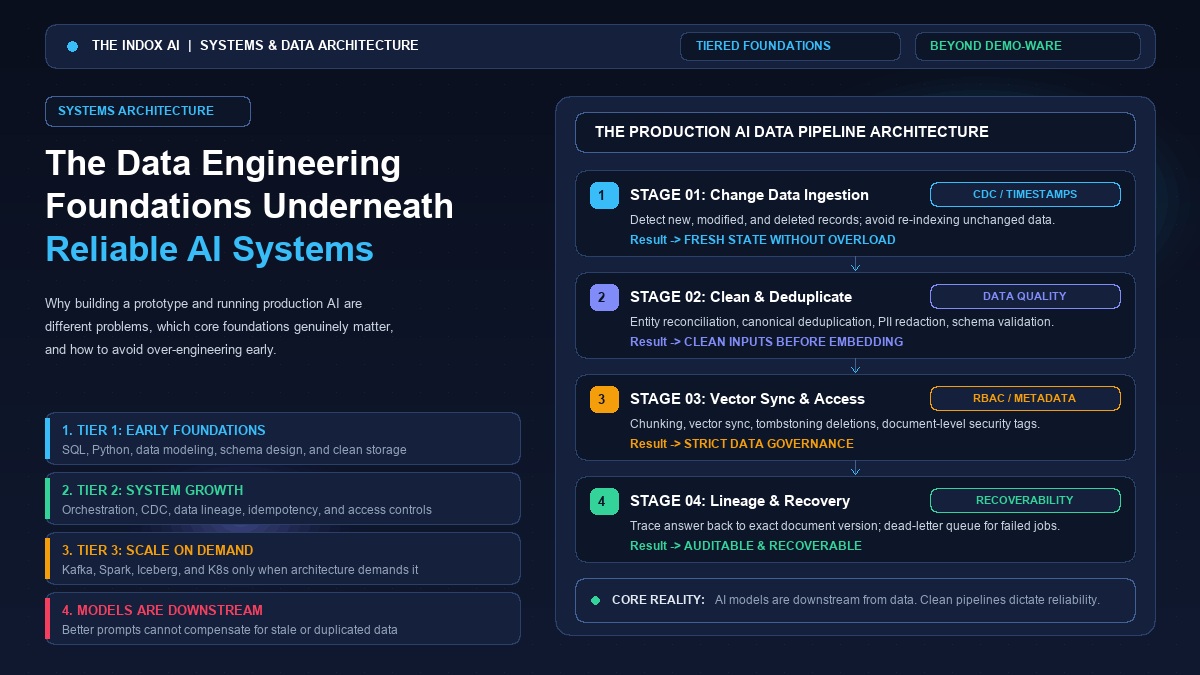
The Data Engineering Foundations Underneath Reliable AI Systems
Examining the architectural backbone of production AI: chunking strategies, embedding pipeline synchronization, relational consistency, and low-latency feature stores.
Your Website Has Bot Protection - So Why Are Bots Still Getting Through?
Deconstructing how headless browser automation, residential proxy rotation, and AI scraping agents defeat legacy CAPTCHAs, and how to build modern behavioral edge defenses.
2026 AI Developer Tooling & Paradigm Matrix
Selecting the appropriate coding paradigm depends on the task complexity, latency sensitivity, and requirement for human verification. The table below outlines how modern engineering teams structure their toolchains:
| Development Paradigm | Representative Tools | Feedback Latency | Autonomy Scope | Ideal Production Use Case |
|---|---|---|---|---|
| In-line Copilots Tab Completion | GitHub Copilot / Supermaven | < 300 ms | Single Line / Function | Boilerplate generation, repetitive syntax patterns, typing autocompletion |
| Context-Aware Agent IDEs Multi-file Editing | Cursor / Windsurf | 1 - 4 seconds | Module / Feature Scope | Feature implementation, refactoring related files, interactive bug fixing |
| Autonomous Terminal Agents CLI Execution Loop | Claude Code / Aider | 10 - 60 seconds | Repository Wide | Test-driven refactoring, dependency upgrades, reproducing CI bug logs |
| Multi-Agent Swarm Rooms Architect + Critic | ChatDev / AutoGen | 2 - 10 minutes | Subsystem Architecture | Complex multi-service migrations, greenfield project scaffolding, security fuzzing |
The 5 Non-Negotiable Rules of Production AI Code
To maintain enterprise code quality and prevent technical decay when building with generative models, enforce these five verified engineering rules across your engineering teams:
- 1. Test-First Constraint Scaffolding Write failing unit tests and boundary assertions before asking an AI model to write implementation code. When an agent has an unambiguous deterministic test suite to validate against, hallucination rates drop by over 80%.
- 2. Run Generated Code in Sandboxed Ephemeral Containers Never allow autonomous agents or AI-suggested commands to execute directly on production or sensitive local environments. Isolate execution within ephemeral Docker containers with restricted network privileges and read-only host mounts.
- 3. Enforce Strict Static Analysis and Linting Gates Configure pre-commit hooks and CI pipelines to automatically run type checkers (TypeScript, MyPy, PHPStan) and linters. Reject any pull request containing unused imports, any-type escapes, or missing docstrings before human code review.
- 4. Maintain Architectural Ownership and Mental Models If an engineer cannot clearly explain how a block of AI-generated code functions or what its edge-case failure modes are, it is not ready for production. Speed of generation should never replace comprehension of system mechanics.
- 5. Protect Web Perimeter with Behavioral Telemetry As autonomous scraping agents become indistinguishable from regular users via standard headers, deploy behavioral fingerprinting, request rate heuristics, and TLS fingerprint analysis to safeguard your APIs and proprietary content.
Frequently Asked Questions
Key clarifications and practical answers addressed by The Indox editorial board.
Does writing code with AI actually make developers faster?
Yes, but with nuances: AI provides a 2x to 5x speedup for well-defined tasks, boilerplate, integration tests, and library exploration. However, for novel distributed system architectures or ambiguous business logic, code generation speed is secondary to clear system modeling and human architectural decision-making.
What is the most effective approach for testing AI-generated pull requests?
Deploy automated preview environments (ephemeral staging links) combined with automated visual regression tools, static security analyzers, and comprehensive integration tests. Require peer code review where reviewers explicitly scrutinize boundary edge cases and data validation.
How should engineering teams protect intellectual property when using AI tools?
Ensure enterprise contracts with model vendors explicitly stipulate zero-data-retention (ZDR) and prohibit the use of customer inputs or codebase repositories for foundation model retraining. For high-security environments, utilize self-hosted or VPC-isolated open-weights models.