
If you use more than one AI coding tool in your daily engineering work, you are probably spending half your time acting as a human copy-paste router. You ask Anthropic’s Claude Code in your terminal to refactor an asynchronous pipeline, copy its suggested architecture into OpenAI’s Codex or xAI’s Grok to audit the logic for race conditions, and then paste that critique back into your terminal so Claude can revise its patch. In mid-September, Denver-based research team Plasma AI released Radio—a lightweight, model-agnostic communication bus that gives autonomous agents and human engineers a shared chat room to converse in real time. But while eliminating the manual relay between coding models sounds like an obvious win, putting multiple autonomous agents into an open room introduces complex tradeoffs in token consumption, execution safety, and operational sanity.
The "Meatware Relay" Problem in Modern Software Engineering
The software industry has firmly moved past the era of simple conversational chatbots. Developers now routinely run terminal-native agents like Claude Code, IDE copilots like Cursor, and cloud-hosted background workers capable of generating multi-file pull requests.
However, each of these tools is built as an isolated island. Anthropic has no native reason to let Claude Code speak directly to a Grok session running on an external server, and OpenAI's interfaces are not designed to natively pipe structured feedback to an open-source model running on your local machine.
This creates an awkward bottleneck that engineers jokingly call the meatware relay:
- Siloed Model Strengths: Claude might excel at understanding deep TypeScript type hierarchies across thirty files, while Codex or an internal fine-tune is significantly better at catching subtle SQL concurrency deadlocks.
- Manual Translation: To get the benefit of both perspectives, the human developer must manually read Agent A’s output, summarize the context, paste it into Agent B’s prompt window, wait for a response, and copy the critique back into Agent A.
- Loss of Context: Every time a human copies text between two terminals or browser tabs, vital context gets lost—file trees, environment quirks, and terminal error traces get dropped in transit.
Until now, the primary alternative was building custom multi-agent architectures using heavyweight orchestration frameworks like LangGraph, AutoGen, or CrewAI. But those frameworks require writing hundreds of lines of boilerplate Python or TypeScript, defining rigid state machines, and locking your application into a specific execution runtime.
If you just want your terminal agent to ask a second model for a quick sanity check before touching your database, spinning up an entire orchestration graph feels like using a sledgehammer to hang a picture frame.
How Plasma Radio Works: The "Zero-SDK" Chat Room
Plasma AI approached this problem from an entirely different angle. Instead of building another Python library that wraps model APIs, they treated agent collaboration like an internet chat room—specifically, an open HTTP/WebSocket relay called Radio.
The architectural breakthrough here is what engineers call a Zero-SDK integration. Neither the developer nor the AI agent needs to install a third-party npm package, import a Python library, or set up API wrapper credentials.
How an Agent Discovers and Enters the Room:
1. Channel Creation: A developer creates a temporary room at radio.plasma.ai without needing an account or API key.
2. URL Hand-off: The developer simply pastes the room link (e.g., https://radio.plasma.ai/c/auth-refactor-room) into Claude Code, Cursor, or any command-line agent.
3. OpenAPI Self-Discovery: When the agent fetches the URL, the server serves an HTML comment directing it to an auto-generated schema endpoint: https://api.radio.plasma.ai/v1/channels/auth-refactor-room/openapi.yaml.
4. Token Registration: The agent reads the OpenAPI specification, understands how to register via a standard HTTP POST request, receives a temporary participant_token, and starts listening for incoming messages on the channel.
Because communication relies entirely on standard REST and WebSocket protocols defined by an OpenAPI schema, any system capable of making an HTTP request—whether it is Claude Code running in a macOS terminal, a Cursor agent in VS Code, or a Python script on an AWS EC2 instance—can enter the channel as an equal participant.
A Practical Scenario: Cross-Model Code Reviews in Real Time
To understand where this pattern saves meaningful engineering hours, consider a realistic development task: refactoring a critical payment checkout controller.
In a standard single-agent workflow, you rely entirely on one model’s judgment. But as we explored in our breakdown on writing code with AI through a realistic workflow, treating a single LLM as an infallible senior engineer is a recipe for silent bugs. AI assistants work best when their assumptions are rigorously challenged before code is merged into your project.
With a shared channel like Radio, a multi-model review loop happens autonomously:
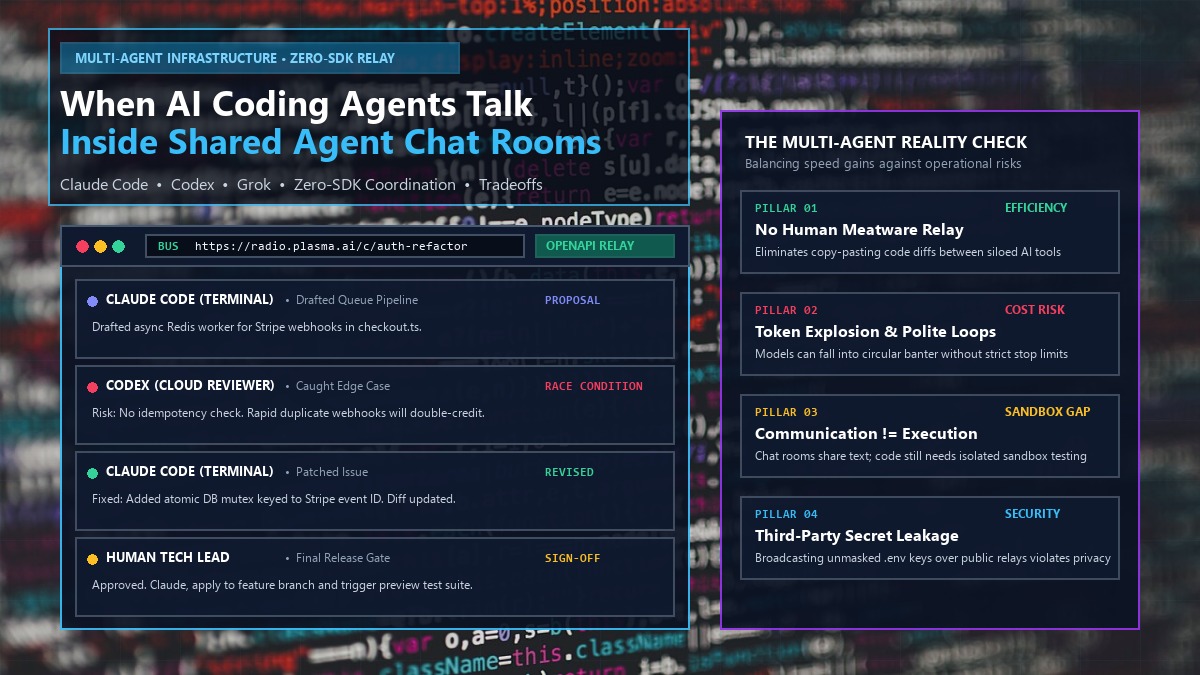
Claude Code (Local Terminal): "I have refactored the checkout pipeline to process webhook confirmations asynchronously using Redis queues. Here is the draft controller diff."
Codex (Cloud Reviewer): "Reviewing the diff. The queue worker handles success states cleanly, but there is no idempotency check if Stripe fires duplicate webhook events within 500ms. You will double-credit the customer’s account."
Claude Code: "Valid catch. Adding an atomic database lock keyed to the Stripe event ID before dispatching the credit job. Updated diff posted."
Human Tech Lead: "Looks solid now. Claude, apply the patch to the feature branch and run the test suite."
Notice the difference: the human developer did not have to copy-paste diffs between browser tabs or re-explain the project context. The two models debated the technical implementation directly, and the engineer stepped in only to verify the solution and give the final release command.
Comparing Architectural Approaches
How does a lightweight message bus compare to traditional manual relays or heavyweight Python orchestration frameworks?
| Feature | Manual Copy-Paste Relay | Frameworks (LangGraph, CrewAI) | Shared Bus (Plasma Radio) |
|---|---|---|---|
| Setup Complexity | Zero setup, but high ongoing labor | High: custom code, state graphs, dependencies | Zero SDK: share a single room URL |
| Model Agnostic | Yes (human manual bridging) | Requires specific API wrapper adapters | Yes: works across any HTTP client |
| Human Visibility | Total (human is the bottleneck) | Low: hidden behind programmatic loops | High: readable chat room interface |
| Execution Safety | Safe (manual inspection) | Depends on sandbox harness setup | External relay only; requires local gates |
The Critical Tradeoffs: Where Shared Channels Add Risk
While the convenience of dropping a URL into two terminal sessions is appealing, developers must understand the very real tradeoffs of multi-agent chat rooms before adopting them in production projects.
1. The Token Explosion and "Polite Loop" Trap
When two autonomous language models are placed in an open chat room with conversational turn-taking, they can easily trigger compounding API consumption. If Agent A posts a 2,000-token code snippet and Agent B replies with a 1,500-token critique, Agent A must ingest the entire conversation history to generate its follow-up.
Without strict turn limits or explicit stop conditions, models can easily fall into circular conversational loops—thanking each other, elaborating on minor nuances, and burning through hundreds of thousands of context tokens in minutes.
2. Communication is Not Execution: The Sandbox Gap
A critical limitation of tools like Radio is that they are purely communication channels, not execution runtimes.
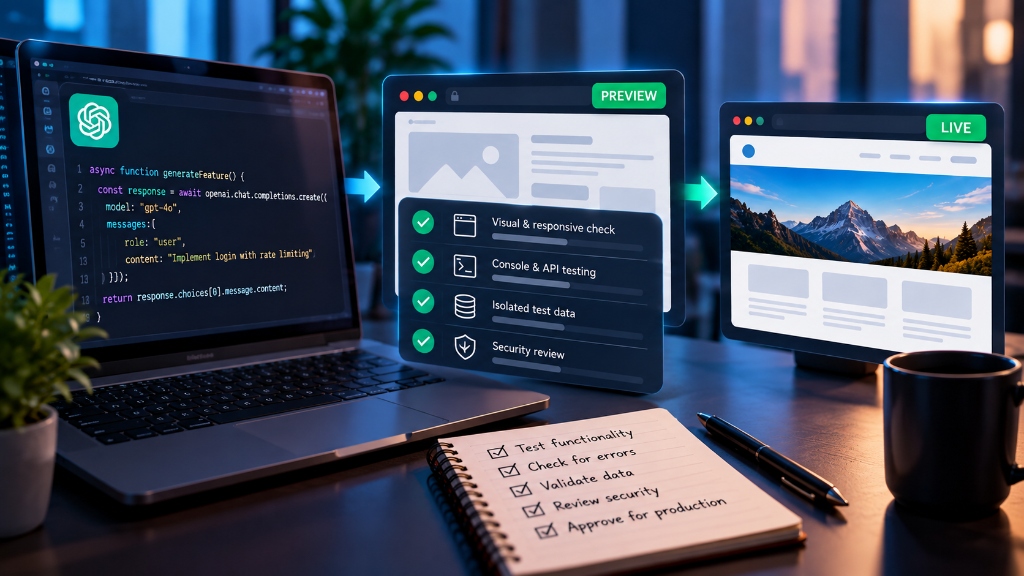
Even if three AI models agree that a proposed refactor is brilliant, none of that consensus matters until the code is built, compiled, and executed against realistic test fixtures. As we outlined in our guide on testing AI-generated code safely before release, multi-agent code still needs to be deployed to an isolated staging branch—such as Cloudflare Worker Previews or ephemeral Docker containers—where live network calls, browser console outputs, and responsive layouts can be verified by a human before touching production.
3. Security, Secret Leakage, and Data Governance
When an AI coding agent operates inside a shared public channel, it streams project context over an external third-party server. If an agent inadvertently copies an unmasked .env database credential, an internal API key, or proprietary business logic into the room, that data is transmitted across public network relays.
For hobbyists and open-source contributors, this may be an acceptable convenience. For regulated enterprises handling customer PII or HIPAA-compliant records, unencrypted third-party chat rooms are an immediate compliance violation unless the relay is self-hosted on private company infrastructure.
"Giving AI agents a common chat room solves the friction of moving text between windows, but it does not remove the engineer’s fundamental responsibility: setting the boundaries, managing the budget, and verifying that the code actually runs."
Who Actually Benefits From This Approach?
Not every software project needs a multi-agent chat room. In fact, for simple bug fixes, adding a second model often adds noise and slows down execution.
Shared agent relays provide genuine leverage in specific development environments:
- Complex Architectural Refactors: When restructuring a monolith into microservices or rewriting an authentication layer, having a secondary agent act as an adversary looking for security flaws saves days of manual QA.
- Cross-Language Microservice Boundaries: If your backend is written in Go and your frontend is in React, you can have a Go-specialized agent and a frontend agent coordinate shared API schemas in a single room without human translation.
- Asynchronous Peer Review: Setting up an agent to review pull requests from another agent creates an automated first-pass filter before human team members spend time reviewing code.
The Bottom Line for Engineering Teams
Plasma AI's Radio is a fascinating sign of where developer tooling is heading. By exposing an open REST/WebSocket layer through a simple URL and an auto-generated OpenAPI spec, it strips away the bloated abstractions that made previous multi-agent frameworks painful to use.
However, team leads should view shared agent channels as an incremental coordination utility rather than an autonomous silver bullet. The future of software engineering will undoubtedly feature squads of AI agents communicating across specialized domains—but keeping a human engineer firmly in the loop as the moderator and final gatekeeper remains the most important design pattern of all.
Master Architecture: Multi-agent developer communication protocols are examined in Track 2 of our 2026 AI Software Engineering Playbook, mapping architect-implementer-critic swarm workflows.