
In the fast-moving debate over artificial intelligence in software engineering, manual quality assurance (QA) is often mistakenly painted with a single broad brush: either as an obsolete discipline soon to be wiped out by automated coding agents, or as an immovable manual bottleneck in modern CI/CD pipelines.
Both views miss what is actually happening on production engineering teams. Software testing is not merely clicking through happy paths and checking green boxes. Quality assurance is an exploratory, investigative discipline rooted in human intuition, domain skepticism, and an understanding of how real users behave under stress.
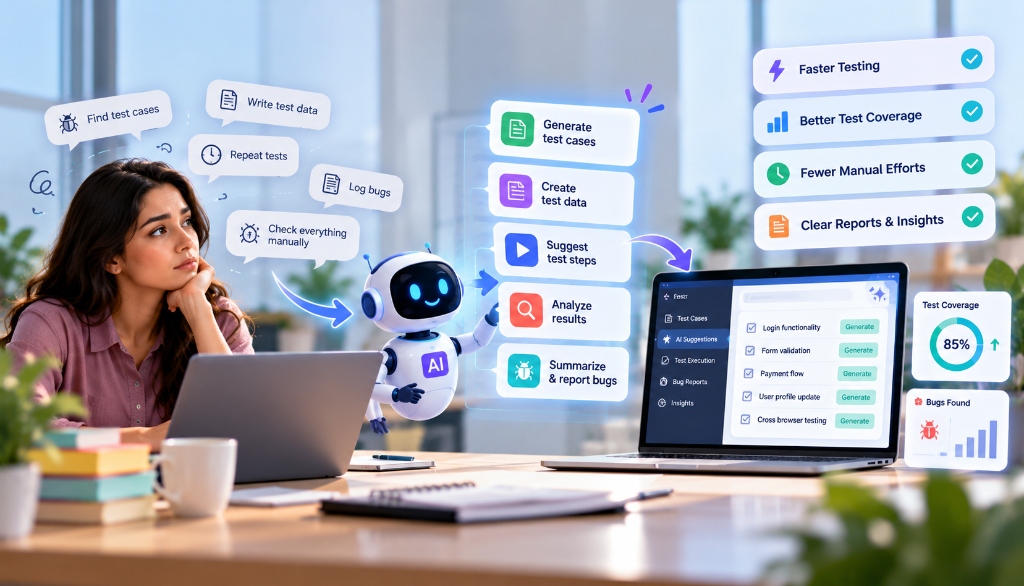
What AI is transforming—rapidly and decisively—is not the tester's intuition, but the repetitive administrative overhead that has long consumed 70% of a manual tester's working week. From generating exhaustive test case matrices out of vague requirements to rechecking complex website updates across dozens of viewports, AI is functioning as a force multiplier for manual testers.
1. The Real Bottleneck in Modern Manual Testing
Consider what happens during a standard two-week sprint. As engineering teams adopt modern developer tools like writing code with AI assistants, feature turnaround has compressed from weeks to mere hours. A product team updates an e-commerce checkout flow: introducing dynamic address autofill, revising tax calculation rules for cross-border orders, and refreshing the payment step UI.
Before a single manual test begins, the QA engineer must typically:
- Read through product requirement documents (PRDs) and parse out implicit acceptance criteria.
- Manually draft dozens of test cases covering positive, negative, and edge-case permutations in tools like Jira or TestRail.
- Craft dozens of synthetic data inputs—mock credit card numbers, malformed postal codes, international phone numbers, and out-of-stock SKU combinations.
- Execute manual regression runs across Chrome, Safari, Firefox, and mobile viewport simulations.
- Retest the entire flow repeatedly whenever developers push subsequent hotfixes.
By the time the tester actually reaches the exploratory phase—actively attempting to break the system with unconventional workflows—sprint deadlines are looming, and mental fatigue has set in. This is where AI tools make their most practical impact.
2. Drafting Test Cases: From PRD to Comprehensive Test Matrix
One of the most immediate productivity boosts for manual testers is using Large Language Models (LLMs) and specialized testing assistants (such as BrowserStack Test Companion, TestSprite, or Claude Code) to scaffold structured test matrices directly from user stories.
Rather than relying on over-complicated prompt gimmicks—as we highlighted in the case against prompt engineering—practical QA prompting succeeds by feeding concrete requirements, explicit constraints, and deterministic test schemas into the model:
"Analyze this checkout requirement: Users can apply promotional discount codes at checkout. One coupon per order. Minimum cart value $50. Cannot combine with flash-sale items. Generate a structured test matrix including:
1. Positive functional tests (valid codes, meeting thresholds)
2. Boundary value cases (cart value exactly $49.99 vs $50.00)
3. Negative & error handling (expired codes, case sensitivity, leading/trailing whitespace)
4. Concurrency & state race conditions (applying coupon while an item goes out of stock in another tab)"
Within thirty seconds, the AI produces a detailed, tabular test suite categorized by severity and preconditions. Crucially, the tester does not blindly accept this output. Instead, their role shifts to editorial review and risk assessment:
- Does this account for our specific third-party payment gateway quirks?
- Did the AI miss our custom regional tax exemptions?
- Are these expected error messages aligned with our brand guidelines?
The tester saves hours of drafting while ensuring zero common boundary cases slip through the cracks.
3. Generating Realistic, Edge-Case Test Fixtures
Anyone who has manually tested an onboarding form or checkout knows the pain of generating valid mock data. Testers often resort to repetitive strings like [email protected], 123 Main St, or asdfasdf, which fail to surface real-world edge cases.
This becomes particularly critical when validating input resilience on public endpoints, where unexpected inputs often mimic how automated crawlers and bots probe for perimeter weaknesses.
AI assistants can instantly generate context-aware test fixtures tailored to internationalization and security requirements:
- Unicode & Character Encoding: Names containing accents (
Zoë,José), non-Latin scripts (Chinese, Arabic, Cyrillic), and right-to-left layout triggers. - Extreme String Lengths: Longest legitimate surnames (e.g., German composite names or Spanish dual surnames) to verify layout wrapping and database column constraints.
- Sanitization & Injection Checks: Harmless string payloads (
<script>tags or SQL syntax snippets) to verify that frontend form inputs escape special characters cleanly before submission. - Complex Geographical Data: Correct zip-to-state pairings across multiple jurisdictions to test dynamic shipping rate APIs.
4. Rechecking Website Changes & Automated Visual Verification
A recurring frustration for manual testers is regression verification after cosmetic or layout changes. A front-end developer refactors a header navigation bar or upgrades a CSS framework. The change shouldn't affect the product page, but subtle visual bugs frequently emerge: buttons overlapping text on mobile, z-index stacking errors, or margins collapsing on specific resolutions.
Manually re-inspecting dozens of pages across desktop, tablet, and mobile browsers after every minor pull request is unsustainable.
Modern AI-powered visual regression platforms (like Percy, Applitools, and automated headless diff engines) eliminate this toil:
- Computer Vision Diffing: Rather than relying on fragile pixel-by-pixel comparisons (which produce false alarms from font smoothing or dynamic ads), AI visual testing models understand UI components natively.
- Noise Filtering: The AI ignores expected dynamic content (such as live dates or rotating banners) while immediately flagging genuine layout shifts, clipped CTAs, or misaligned pricing tags.
- Viewport Orchestration: The system automatically captures baseline and candidate screenshots across hundreds of device configurations simultaneously, delivering a consolidated visual changelog for the tester to approve in seconds.
5. Bridging the Gap: Turning Manual Steps into Resilient Automation
Historically, a steep wall separated manual testers from test automation. A manual tester would discover an intermittent defect, write up reproduction steps, and pass it to a software development engineer in test (SDET) to script a Playwright or Selenium test.
This mirrors the architectural principles behind testing AI-generated code in preview environments before merging. Today, agentic testing companions (like BrowserStack Test Companion, TestMu Kane CLI, and Checkly agent skills) allow manual testers to bridge this divide directly:
The Agentic QA Loop:
- 1. Record in Real Chrome: The tester performs the exploratory flow naturally in a real browser session.
- 2. Context-Aware Synthesis: An AI companion records not just mouse clicks, but DOM hierarchy changes, network API payloads, and console telemetry.
- 3. Self-Healing Selectors: The agent translates the recorded flow into clean, structured Playwright code using resilient, accessible locators (like
getByRoleandgetByLabel) instead of brittle absolute XPath paths. - 4. Instant Regression Asset: That one-off manual bug verification becomes a permanent, automated regression check in the team's CI pipeline.
6. Intelligent Failure Triage and Root Cause Analysis
When an unexpected error occurs during testing—for example, clicking "Place Order" results in a generic spinning wheel—manual testers often spend considerable time gathering reproduction data: opening DevTools, copying network response payloads, collecting console errors, and identifying which microservice failed.
AI testing assistants now perform immediate triage on session failures:
- They analyze the exact sequence of DOM events immediately preceding the stall.
- They correlate the UI action with corresponding HTTP 4xx/5xx network responses.
- They draft a comprehensive, pre-filled bug report: exact reproduction steps, environment details, relevant stack traces, and a preliminary hypothesis of whether the issue is client-side or backend-related.
7. The Crucial Boundary: What AI Cannot Do
Despite rapid advances in testing agents, it is critical to recognize the fundamental boundary of AI in quality engineering:
A passing AI-generated test only proves that its specific assertions passed. It does not prove that the software behaves correctly for human beings.
AI models excel at pattern matching, data generation, and deterministic verification against given rules. But AI lacks:
- Business Context & Trade-offs: AI does not know that a 200ms latency spike is acceptable during Black Friday checkout surges but catastrophic for a real-time trading platform.
- Human Usability Judgment: An AI cannot tell you that a checkout modal is confusing, that a color contrast ratio feels fatiguing, or that a user journey creates friction.
- Chaos & Unpredictable Behavior: Real users do bizarre things: clicking the "Back" button mid-payment, opening three checkout tabs simultaneously, or switching network connections mid-upload. Formulating hypotheses around these edge cases remains an intensely human cognitive skill.
Looking Ahead: The Augmented QA Engineer
The narrative that AI will eliminate manual testers fundamentally misunderstands where testing value comes from. Much like diagnosing which business automations actually save time versus those that create maintenance overhead, the goal in QA is not to automate for the sake of buzzwords.
By delegating test matrix drafting, synthetic data preparation, and visual change rechecking to AI companions, manual testers can reclaim their time for what truly matters: deep exploratory testing, risk-based architecture reviews, and advocating for an intuitive, resilient user experience.
Master Architecture: Software test automation and QA engineer augmentation are detailed in our 2026 AI Workflow Automation Guide, evaluating synthetic edge-case generation and exploratory test matrix tools.